Lawrence Brewer
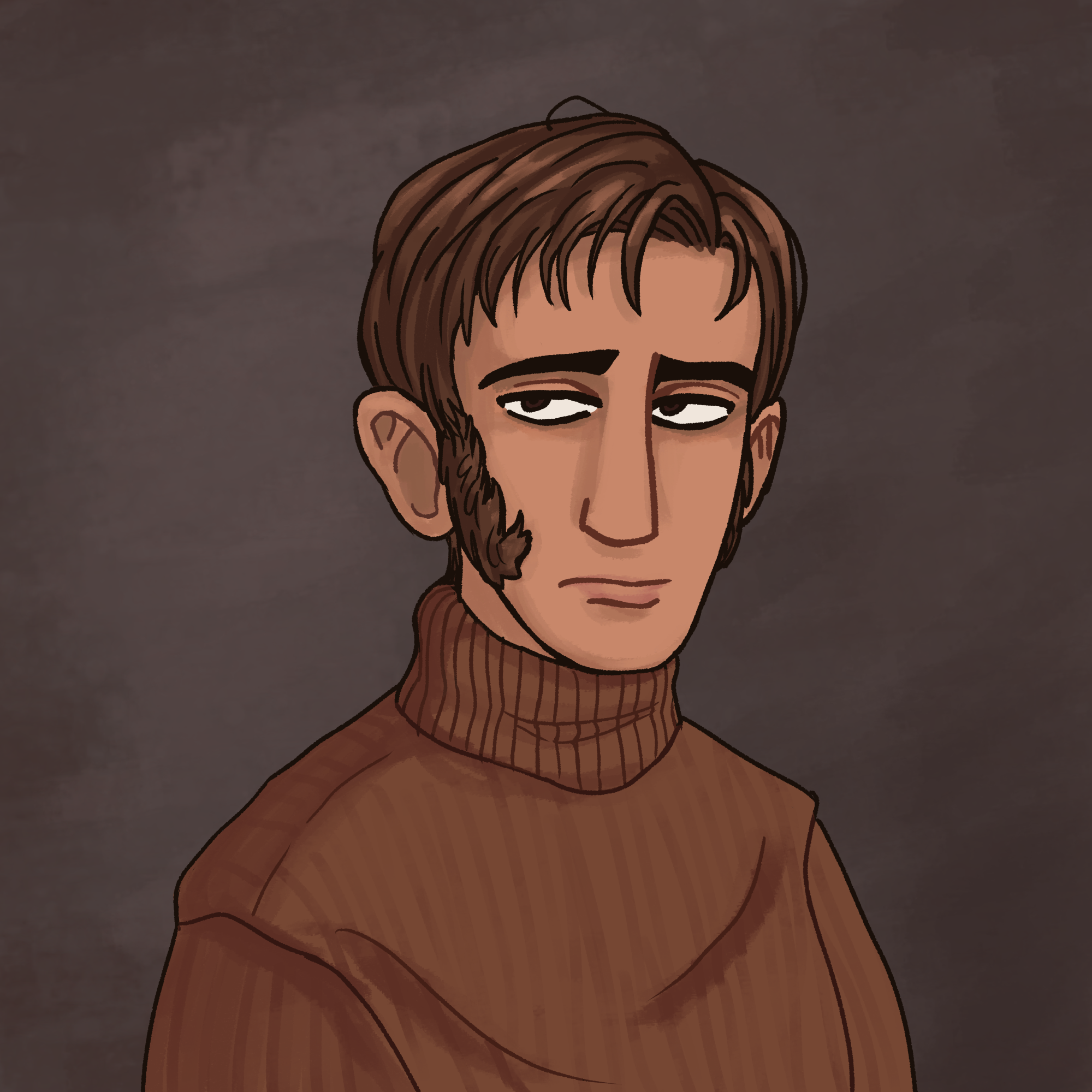
Born: June 16, 1879 | Gastown, British Columbia, Canada
Role: Zoologist
Height: 5' 6" | ???cm
Polar experience: One expedition
A conservationist, does his best to respect and understand nature. Gets ridiculed for his beliefs; he's also a bit awkward, so he doesn't have many friends. A passive observer. Often feels overlooked, and that he doesn't have the power to make a significant difference in important situations.
Biography
Early life
Lawrence Brewer was born the youngest of three children, with one brother and one sister, in the then-small Gastown in the far western reaches of Canada. His father worked at a sawmill, but was an artist in his spare time, with a particular affinity for painting the beautiful, nearly untouched landscapes that British Columbia had to offer.Lawrence loved to accompany his father on painting trips, as otherwise the man was often busy with his demanding job. This sparked a love for nature within the boy, which guided him to become a scientist as he grew older, with a particular focus on zoology. Seeing how his hometown had rapidly changed in the following years also inspired an intense desire to preserve nature, and find a way for mankind to coexist with it.
Turbulence to Stability
Brewer began his work promptly after the expedition's arrival in Antarctica. He often worked together with the biologists on the scientific team, but the nature of these relationships and interactions had not a hint of warmth or camaraderie. He was well aware that his coworkers were only tolerating his presence on the team, and did his best to accept the situation.
Brewer's interest was piqued by the emergence of Austral hypothermia, particularly the fact that it affected both humans and dogs. He was rather keen on studying it, but did not put in a request to do so with neither (SCIENTIFIC LEADER) nor the dog handler, Kyrre Mortensen. His hands were already nearly full with another project and didn't think that either party would consent to the arrangement.
Imagine Brewer's surprise when, a few days later, Mortensen himself came directly to him, asking him to help his dogs. He learned about the situation that occurred between Mortensen and Captain Hawthorne and felt obligated to help. He made it clear that he could dedicate only sparse free time to studying the dogs, and that he might have to conduct some seemingly cruel experiments in order to gather the proper data. This was a great source of internal conflict for Mortensen, but he ultimately agreed to the arrangement and left some of his dogs in Brewer's care. Brewer studied them diligently, being sure to be thorough with his documentation of the illness's effects, but was filled with worry that his work would not actually do anything to ease their pain or Mortensen's worry. He also wondered how attempting to cure a disease fit into his philosophy of letting nature take its course, no matter how grim or upsetting for humans. But, after seeing Mortensen so distraught and protective over the poor creatures, surely exceptions could be made, especially for domesticated animals? Where was the line to be drawn?
While these philosophical musings ran in the background of Brewer's mind, he was building a rather good rapport with Mortensen, who made frequent visit's to the biology hut to check on his dogs and ask for progress updates. They found much to bond over, especially in their mutual love for nature, and how they fit into the wider dynamics of the crew. Finally, it seemed that Brewer had someone on the expedition whom he could consider a friend.
Tragedy and Discoveries
One morning, the crew woke up to find Mortensen dead outside the dog kennels, and Captain Hawthorne injured and unconscious alongside him. Brewer, having lost his truest companion on the expedition, was naturally very affected by this turn of events, even more so when the surgeons examined his body and concluded that some sort of animal must have attacked him. From what he had seen of the gruesome scene though, the carnage did not resemble the work of any animal he was familiar with, especially those native to Antarctica. Brewer felt obliged to do something, both to solve the mystery of his friend's death and to advance his own scientific field. He reached out to the commanding officers, presenting his hypothesis of an undiscovered predator and proposing a party be arranged to go look for it. The officers did not need much convincing, to Brewer's surprise, thinking that such a venture would be good to boost morale and ease the crew's worries in the wake of Mortensen's death.
Brewer was accompanied on this party by Lieutenant Graham Murphy, (PETTY OFFICER), and (PETTY OFFICER). There had been some anticipation that Hawthorne would participate as well but he declined, citing his injuries from the attack. Brewer found this a bit strange, as he had overheard that those injuries were not as severe as the initial discovery implied, but ultimately contemplating the captain's decisions was not his main priority. The party began tracing the Antarctic coast, heading west, as the kennels were located on the western outskirts of the camp and Brewer theorized that the mystery animal probably did not venture to the shore from the Antarctic interior to find prey.
Eventually, the party seemed to succeed in finding their target, catching sight of a large, seemingly-mammalian creature in the distance, near a colony of penguins. Brewer had been intent on watching it from a distance, without any human interaction, so he could take notes on its natural behaviors. His plans were sent awry when Murphy observed the beast beginning to attack the penguins and intervened by shooting the predator with his rifle. Brewer was frustrated and shocked at Murphy's decision, but felt he had little power to do anything but collect the body and haul it back to camp.
The crew cheered upon the party's return, believing that Mortensen's killer would no longer be a threat, which further frustrated Brewer, who silently took the body to his workspace to conduct an examination. As he had almost come to expect (and dread), he concluded that the creature, which became known as the snow griffin, could not have been what killed Mortensen. It had an avian beak, much like a bird of prey, with no teeth. Mortensen's body was covered in tooth marks. With heavy heart, he gave a short presentation to the crew on his findings the following day. This presentation was controversial and unfortunately did nothing to quell the crew's mounting anxiety.
UNDER CONSTRUCTION :-)
Appearance
Slightly below average height, with a slender build; not very athletically capable. His skin is tan from time spent outdoors, and he has short, straight brown hair and brown eyes. His brow bone is quite heavy, giving him a rather serious, somber appearance most of the time. His face is long and his nose is long and straight. He has sideburns and his ears are rather prominent.
Brewer has a slouching posture, and sometimes does odd gestures or fidgeting with his hands when he's nervous. His usual expression suggests that he is often lost in thought or thinking about something different to most other people in a room. Always seems a little tired, his movements are usually slow and reserved.
His voice is deep and slightly husky, though he usually speaks too quietly to have much of a presence in conversation. Sometimes rambles about details relating to his field of study or other things he happens to be interested in or passionate about, but usually corrects himself fairly quickly.
Trivia
- Brewer was originally envisioned as a Danish seaman named Lauritz Breining. He was also planned to be Mortensen's romantic partner. Brewer probably could've had a romance too, if it weren't for Mortensen dying so early in the story.
Gallery
Portrait - 2026
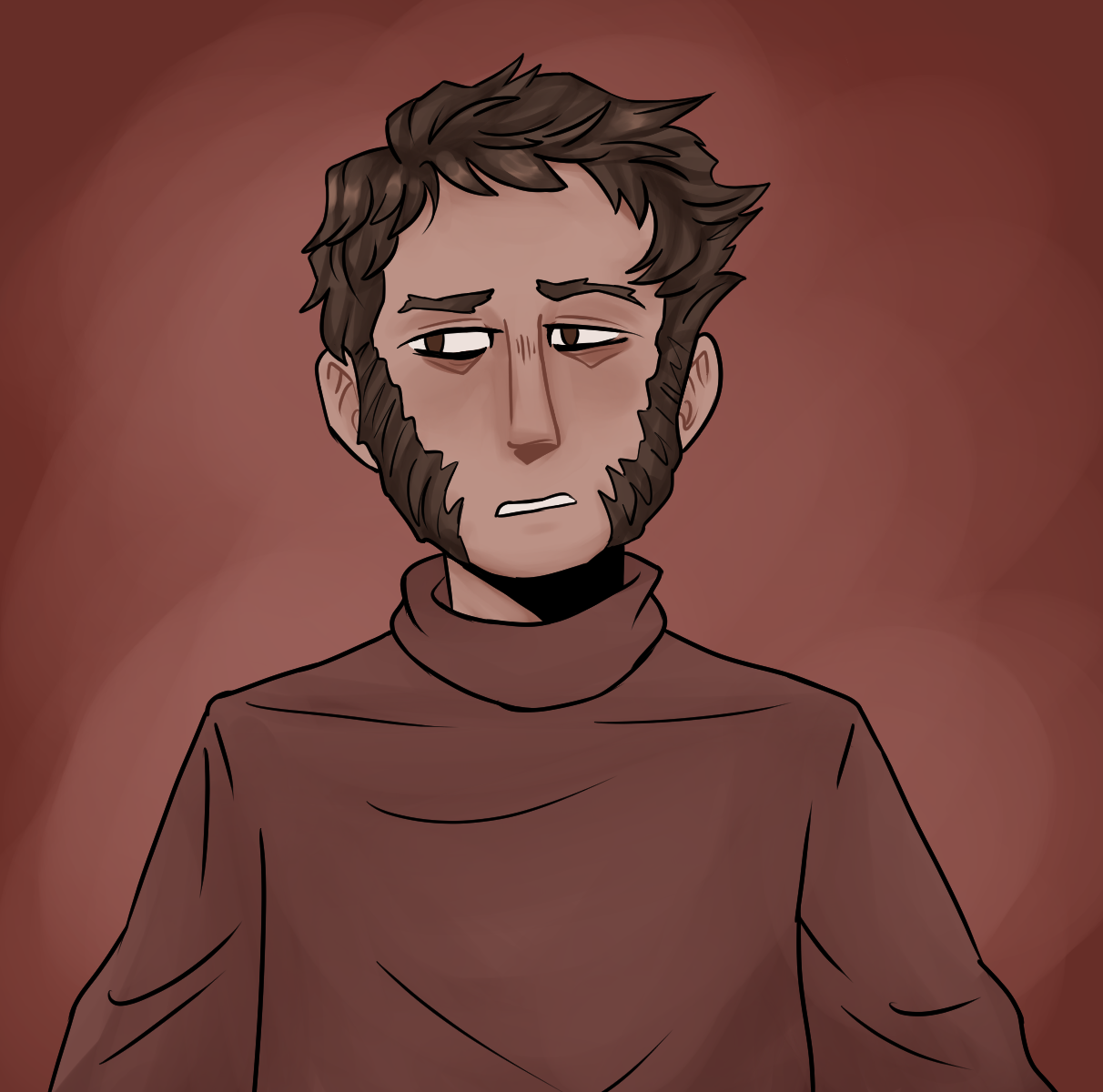
Portrait as Lauritz Breining - 2021 (outdated)