The Officers
Captain - Head officer of the ship. Responsible for directing the other officers and ensuring the success and safety of the ship's voyage.
Mate - Officer or tradesman that supports and assists their superior. General mates help to run the ship and serve at the Captain's request. Tradesmen mate serve their superior.
Bosun - [Alt. Boatswain, Bos'n] Foreman in charge of general crew operations and the equipment required to sail the ship.
Gunner - Military officer in charge of weapons and military procedures on the ship.
Purser - Administrative official. Accounts for all cargo value and trade transactions. Manages a small item store for crew.
Surgeon - The ship's doctor, in charge of crew health. Capable of general care and medical procedures as required.
Carpenter - Tradesman responsible for maintaining the integrity of the ship's wooden structures.
Helmsman - Rated seaman in control of the ship's wheel and general moment-to-moment navigation.

1 - Robert Witterel
Role: Captain
Origin: England
Appears in: 15 memories
Accepted fates: Suicide by gun
Story Summary
Robert Witterel makes his first appearance in Murder Part 2, declaring Hok-Seng Lau's sentencing to death for Nunzio Pasqua's murder and ordering Christian Wolff and the firing line to execute him.

He appears in Unholy Captives Part 1 after this, where Chioh Tan has been apprehended after murdering Edward Nichols. Witterel has Huang Li translate for him so he can interrogate Tan about what he knows. He asks Tan what he knows about the chest and the other dead Formosans. Tan replies that the shells must be protected and everyone will die. Witterel asks what he means by "shell", but before he can get an answer, one of the mermaids shoots out several spikes, which kills Tan and Hamadou Diom. Another spike also lands between Witterel's feet, nearly injuring him. In Part 2, he orders the crew to move the boats to the back of the ship and dispose of the bodies that now litter the main deck. A group of officers, consisting of William Hoscut (who happens to be his brother-in-law), Martin Perrott, Christian Wolff and Olus Wiater, gather around him as he continues to speak, presumably giving out more orders to them. In Part 4, he orders Charles Miner to restrain Fillip Dahl after he attacks John Naples and severs his leg. He questions in disbelief why Dahl would act so irrationally, citing that he never had doubts about him in the twenty years that Dahl has been his steward. Dahl insists the mermaids are cursed, and Witterel tells Miner to put him in the lazarette.
Witterel makes a brief and obscure appearance in Soldiers of the Sea, appearing on the stairs between the gun deck and orlop deck during Part 7. He wields one sword in each hand, and exclaims that the crab riders are trying to reach the lazarette. He is entirely absent from The Doom, instead appearing in Bargain during this time frame. In Part 2, he yells at a mermaid being held captive in one of the tanks inside the lazarette, demanding for her to call off the kraken's attack. He then shoots her dead with his pistol. He then moves to the adjacent tank and picks up a spear, again threatening to kill all of the mermaids if they do not call off the kraken. He then impales the second mermaid with the spear. These threats seemingly work, as the third mermaid is left alive and he exits the lazarette, telling John Davies and possibly others that he "chased off" the kraken. He also retrieves the shells from the dead mermaids and tosses them overboard, as stated by Paul Moss in Bargain Part 4. It is likely around this time that he is informed his wife, Abigail Hoscut Witterel, was killed during the kraken's attack, and her body is moved to a bed within the captain's quarters.
He then appears in Escape Part 1, walking up to the main deck while Hoscut walks out of his cabin. In Part 2, Leonid Volkov attacks the escapees and kills Paul Moss. Witterel yells at him to let them go and prepares to fire a warning shot, but the topman does not listen to him. He then takes aim with the intent to shoot Volkov in Part 3, but Emily Jackson beats him to the punch. The surviving escapees flee and Witterel leans down onto the railing of the aft deck, clearly in defeat.

In The End Part 1, Hoscut and Henry Brennan make threatening demands regarding the mermaid's shells outside the captain's quarters. Witterel flings open the door, wearing only his shoes and pants and fires a shot at Hoscut, killing him. Brennan then grabs a spear and rushes inside, again asking where the shells are. Witterel says they're at the bottom of the sea, but Brennan does not believe him. The two get into a scuffle that results in Witterel being stabbed in the shoulder area and Brennan's throat being slit by a knife. Lewis Walker then enters the cabin through the balcony in the back, and stabs Witterel in the side with a knife. The captain cries out in pain but quickly removes the spear from his shoulder and strikes Walker in the head with it, killing him. Now the last living man on board, Witterel sits down in a chair near the bed where Abigail's body rests. He confesses his regrets to her, particularly surrounding his murder of her brother, William Hoscut, and begs her for forgiveness, before shooting himself in the chest.
Interpretation
I have some strong opinions on Witterel and his actions. Initially, his actions are understandable for a man of his time, not really trusting/understanding the Formosans and taking the mermaids as "loot", perhaps purely for monetary gain or for scientific advancement. But as time goes on, it should become deeply clear that it is extremely dangerous for the crew's wellbeing that the mermaids continue to be kept on board, as they summon increasingly dangerous beasts to come free them. And he even recognizes this fact because he calls out that the crab riders are trying to get to where the mermaids are, but still decides to keep them captive! It reads as incredibly stubborn to me, and that he doesn't really consider the problem of his crew dying as serious enough to change his plans.
There is also something to be said about the fact that he seemingly recognizes the mermaids as being possibly intelligent creatures but still chooses to treat them essentially as animals. He shouts threats at them, maybe initially out of desperation but it seems he does realize that they understand him because he doesn't kill all three of them. Even still, he keeps her locked up in the lazarette, near the corpses of her fellow mermaids. Of course, we are unable to see the aftermath of his rampage because no deaths occurred, but I don't get the impression that Witterel had a polite discussion of what was going to happen next with her. He recognizes her intelligence but treats her without a hint of dignity or humanity. It makes you wonder about how he treated the non-English (and particularly non-white) among his crew.
Something that I tend to overlook in regards to this part of the story is that Witterel was the one who threw away the first two shells, presumably after the mermaids that held them were dead. And why did he leave the third one in Dahl's hands? Why didn't he want Dahl's body to be disposed of? Did he simply not notice or care about it amidst all the chaos and probably very strong emotions during the time?
Despite his overall ruthlessness, we do see he is capable of showing some restraint in Escape, where he initially tries to make a warning shot for Volkov before changing his mind and taking direct aim. He also approves of the escapees' plan, though it's hard to say whether that's because he knew about it in advance or wanted them to be shown mercy in the split second that he became aware of it. I always thought of it as the former, but who knows. But still, I think it's sort of too little too late. We see him show some remorse for what happened in Escape but remorse doesn't bring back all the people whose blood are on his hands.
I more or less understand why Hoscut was pushed into mutinying against Witterel, but I've often wondered about why Witterel was compelled to shoot him. Yes, it's what any captain would do if he was being rebelled against, but surely he would've given more pause to shooting his brother-in-law, right? Was the mental pressure from the death of Abigail and most of his crew so great that he maybe didn't even see that connection in the moment, only recognizing a rebellious first mate? It's very strange, and again speaks to a certain ruthlessness to Witterel's character.
Overall, I don't think Witterel is uniquely malicious in his actions, but they are incredibly ignorant, stubborn, and indicative of the inherent malice that exists in hierarchical and colonizing entities like the East India Company. He is merely one symptom of a much larger issue.
Headcanons
To lighten things a bit, I'll say that it is interesting to wonder how exactly the Witterel-Hoscut trio came to be. The common consensus among fans seems to be that Witterel and Hoscut were midshipmen together, became good friends, and then Witterel met his sister and the rest is history. I like this idea, so I also subscribe to this headcanon. I think another popular headcanon is that Abigail is a very headstrong and carefree person, and that's why she ended up accompanying Witterel during his voyages. I would've said I can't imagine he's thrilled about the prospect of that but then again he doesn't seem to put much consideration into his crew's safety so who knows lol. Maybe he's been in the captaining business for so long that he's kind of forgotten that he isn't immune to having disaster befall him.

2 - William Hoscut
Role: First Mate
Origin: Scotland
Appears in: 14 memories
Accepted fates: Shot with a gun by Robert Witterel
Story Summary

William Hoscut first appears in Murder Part 2, standing near Captain Robert Witterel's side as he gives out the orders to execute Hok-Seng Lau. He then appears in Unholy Captives Part 1, a bystander as one of the mermaids kills Chioh Tan and Hamadou Diom. In Part 2, he is among the officers that are gathered around Witterel as he speaks to them. Again in Part 4, he watches on as Fillip Dahl is apprehended and brought to the lazarette.
He finally takes action in Soldiers of the Sea Part 4, where he aims a musket up towards the second crab rider as it enters the gun deck. In Part 5, he takes cover behind a wooden partition, but peeks around the corner for the crab rider. In Part 7, he gets cornered by the crab rider and attempts to fire, but a repeated clicking sound can be heard, suggesting that his musket has jammed up. He shouts for someone to shoot it instead, and although Charles Miner tries to do so, he misses. It is unclear how Hoscut gets out of this tricky situation from here, but somehow the crab rider ends up not finishing him off and instead heads for the cargo hold.

Hoscut is absent from The Doom, and next appears in Escape Part 1. He is seen exiting from his cabin, while Witterel climbs up the stairs to the main deck. Later on in Parts 2 and 3, he and Henry Brennan run towards the ship's aft deck as Leonid Volkov attacks the escapees and kills Hoscut's steward, Paul Moss. After Volkov is killed they stop their pursuit, but their attention is soon caught by the commotion coming from the gun deck. Hoscut runs down to see Thomas Lanke and the huge trail of blood that he has left behind him, and rushes into the midshipmen cabin to comfort the boy. Hoscut assures him that he won't leave his side and, when Lanke asks him to tell Peter Milroy's mother about his failed attempt to save his life, he tries to ensure him that he'll be able to tell her himself. He then calls for Brennan to bring him the surgeon's kit, though Lanke bleeds out before this request can be acted upon.
Finally, Hoscut appears in The End Part 1. There, he is seen without his undershirt and hat, only wearing his pants, shoes, and jacket, and also wields an axe. He knocks on the door and demands Witterel to let him and Brennan in. Brennan urges him to kick down the door instead. Hoscut continues, threatening Witterel's life in exchange for the shells. Witterel then flings the door open and shoots Hoscut with a pistol, which incidentally blasts off a few fingers on his left hand and pierces his chest, killing him.
Interpretation
When I was writing down the summary above, it really struck me for the first time how little Hoscut, the first mate, actually does to affect the plot (or even just the scenes he's in) up until the very end of Escape and the very first part of The End. He really is just a passive observer for most of the events, seemingly until too many people that are close to him start getting hurt. Obviously, he's in an interesting position having his own brother-in-law act as his captain, but I'm not sure how exactly it would affect their dynamic since we don't get much concrete information on the three involved parties' characterizations. To focus purely on canon facts though, Hoscut at the very least seems to be pretty compliant about all the decisions that Witterel is making up until he and the others are the last remaining crew on board. Learning of Abigail's death, whenever that is, has to make for a pretty substantial turning point in this as well, I have to imagine, as does having a young midshipman die in his arms. His steward also dies, but curiously we never actually see Hoscut and Moss together in a scene, so it doesn't seem like they had a very strong bond like many of the other officer-steward pairs.
I find Hoscut's conversation with Lanke as he dies in Escape Part 4 to be one of the game's strongest and most emotional moments. It is so nice (and sad) seeing and hearing how tender he's being with Lanke there, when up until now he's been this stony-faced Scotsman who occasionally yells about his malfunctioning gun. A heart of gold lies underneath the stern exterior that he seeingly puts up. Additionally, Lucas Pope has stated that the reason Lanke's body was kept on board when Davies and Wiater's weren't is that the crew had intended to return him to his family. Although he attributes this decision to the entire (remaining) crew, I have to imagine that it was specifically Hoscut's idea. I feel like this general incident implies a pre-existing relationship between him and Lanke, but I'll discuss that more in the headcanons section.
But then, in complete contrast to this tender moment, we have Hoscut staging a mutiny against his brother-in-law. As mentioned, I feel like Hoscut has been sent into a very emotionally bad place by the end of Escape due to all the deaths that surround him. It's possible that he came to his own conclusions to commit mutiny after this, but I have a pet theory that Brennan was a major influence in him making thiat decision as well. We do see him literally telling what Hoscut to do in The End, kind of like a little devil on his shoulder as I like to imagine it. It is strange to me that he seems to be primarily concerned with the shells, when he doesn't really have any indications of greed before. Perhaps his desire to get the shells is more safety-oriented, wanting to throw them back to the sea so more people don't die. Maybe not even saving himself, but anyone else that may eventually stumble upon the ship and find the shells on board. But his demand for the shells is also interesting in that it reveals that he wasn't aware of Perrott's actions in the lazarette (and his steward's actions on the main deck after), which seems like an important thing for him to be left in the dark about. Perhaps the fear of word getting out about what they did was so great that anyone who wasn't directly involved wasn't informed, regardless of rank.
One last thing I'd like to point out that there are some strange objects hanging on the wall inside his cabin. A very astute fan from Twitter managed to identify these objects as quaichs, a traditional Scottish drinking cup. It's a very obscure hint to Hoscut's identity, sure, but so obscure I don't think it would actually be very useful for most people. I think it's more of an indicator that he is very proud of his heritage and is intent on holding onto it while working for the East India Company surrounded by many English officers.
Headcanons
I go into this in further detail on the midshipmen page, but I have a headcanon that Hoscut and Lanke knew each other prior to Lanke becoming a midshipman, having met due to the Lankes owning a shipbuilding business. Furthermore, I think that they maybe didn't have enough resources set aside specifically for Thomas to become a midshipman (the fee was infamously expensive), and so Hoscut pulled a favor for him to get a midshipman position with the East India Company. I think it explains why, out of all people, Lanke was kept on board to be brought home. Hoscut was friends with his family, and had developed a bond with the lad before he tragically died in his arms.
I also like the headcanon that Hoscut is gay. I don't really have any big thoughts on that further that I want to say but yeah. He seems gay to me!

3 - Edward Nichols
Role: Second Mate
Origin: England
Appears in: 9 memories
Accepted fates: Shot with a gun by Chioh Tan
Story Summary
Edward Nichols first appears in Murder Part 1. In it, he has knocked Hok-Seng Lau unconscious with a club and has broken into the passengers' cargo with plans to steal the Formosan chest. One of its drawers has been opened to reveal a glowing shell, but Nichols is interrupted when Nunzio Pasqua enters the cargo hold to investigate the strange noises. Nichols approaches and attempts to play it off, claiming he was just "sorting some things". He then tells Pasqua to watch his step before suddenly stabbing the man in the chest with a knife, killing him. This forces him to abandon his attempt to steal the chest. He subsequently appears in Part 2, in which Lau is executed after supposedly confessing to murdering Pasqua. His steward, Samuel Galligan, can be seen whispering something into his ear as the guns are fired.

Nichols then chooses to take more drastic actions to make away with the Formosan chest. He, along with a crew of mutineers (consisting of Galligan, Patrick O'Hagan, Li Hong, Alarcus Nikishin and Aleksei Toporov), kidnap Bun-Lan Lim and It-Beng Sia, steal their chest, and attempt to escape using the ship's two launch boats. Along the way, they meet resistance from a few crew members on the main deck but are able to overcome all of them. The last of these crew members is Timothy Butement, who approaches Nichols with a knife in hand. Nichols holds Lim captive with one hand and a pistol in the other, which he uses to kill Butement. The mutineers then depart for the open seas.
Nichols gives commands to his crew in The Calling Part 1, explaining that they are heading for the Canary Islands. He also confirms that Galligan has packed enough supplies to last them the three days that he says it will take to get there. Suddenly, mermaids attack the boats and begin killing the crew, starting with Li Hong. Nichols tells the men to keep rowing, while he scans the water for the creatures. He fires at one of them but seemingly misses. O'Hagan asks to be given a weapon but Nichols only tells him to keep rowing, before the seaman gets speared in the neck. Seeing that his plan is falling apart yet again, Nichols takes cover at the bottom of the boat, curling himself up into a fetal position while his crew and his hostages are picked off one by one.

Things begin to quiet down after Sia uses the shell and chest to stun the mermaids with magic. Nichols emerges from hiding and evidently decides that the bodies of the mermaids may be useful to him. He throws the corpses of his crew overboard to make room for the mermaids, which he takes on board while Sia dies from the injuries he sustained due to the chest. He then ties the boats together and begins rowing one of them back in the direction of the Obra Dinn. Once he returns to the ship, he calls out for attention, but is met with the barrel of a musket through one of the gun deck portholes instead, belonging to Chioh Tan, the last living Formosan. He pleads for his life, claiming that he has treasure. Tan does not, or cannot, listen to him and fires, killing him.
Interpretation
Augh this bastard. The guy that can be more or less blamed for nearly every death in this game (though I think Witterel can also take partial credit for that too). Not only is he greedy and mutinous, we also see that he is a coward and, in my opinion, a terrible decision maker. I cannot fathom why he thought killing Pasqua would've been an appropriate reaction to the guy wandering down into the cargo hold. He could've so easily told him to just turn around and go back to bed using his authority but no, he just had to stab the guy and create a much bigger mess for himself for some reason. Perhaps he somehow already had the foresight to pin the death on Lau, therefore allowing him even better access to the Formosan chest? Despite things getting more complicated, the turn of events did allow him to also kidnap the Formosans (presumably for ransom), not just steal the shell which is what it seems like he initially planned on doing.
I find it a curious detail that aside from Nichols himself, every single member of his mutinous crew is not from England. I think it was intentional on his part, reasoning that they would be less loyal to the captain and the East India Company as a whole, and perhaps more desperate to make money as well. It probably would've made his plan to go to the Canaries a bit "easier" as well, since those were and still are controlled by the Spanish, at the time an enemy of the English. I wonder what his plan was once he got there, besides the obvious selling the shell and chest for money and holding the Formosans for ransom. Was he perhaps planning to defect to the Spanish navy or something?
Many people have noted that Nichols's cabin is furnished strangely, being full of what looks to be cargo with no signs of any "sentimental" items. One fan noted that in real life, Company officers were allowed to bring their own cargo to sell in the places they sailed to, and perhaps this is what we're seeing happen with Nichols. If so, it goes to show how much money seems to drive his decisions. We even sort of see this during his final moments as well, seeing him attempt to bargain with Tan for the chest. It's very ironic though, as he doesn't seem to realize that chest already belonged to him and the other Formosans. I wonder if he planned on actually giving up the chest in exchange for his life, or if he was just saying anything he could think of in the moment.
Headcanons
I imagine Nichols as someone who had a somewhat difficult childhood. He was upper class, but for some reason never really had his parents in his life and was constantly being shifted around to various aunts and uncles and other relatives to care for him. When he eventually wound up in the East India Company as a midshipman, I imagine this is where he first met Galligan, probably working as a steward for another officer at the time. An unlikely... "bond" formed between the two, with Nichols sort of subconsciously craving some sort of father figure in his life. They have a very strange and certainly not healthy relationship as time goes on and Nichols eventually becomes an officer and Galligan winds up as his steward. I imagine Nichols as always being a sort of messy and careless person, literally and figuratively, and Galligan always has to be the one to clean up his messes.
Building off that, I think Galligan was the person who did most of the recruiting for the mutiny scheme. I can't really see Nichols, arrogant bastard he is, wanting to busy himself with such a task. It would probably be a lot more suspicious for him to be directly recruiting too, as the second mate.
I think Nichols can be charismatic if the situation calls for it, but he perhaps isn't as charismatic as he believes himself to be. He's all grandeur but no real substance, and he doesn't actually like socializing that much at all. He treats people in a very utilitarian manner.

4 - Martin Perrott
Role: Third Mate
Origin: England
Appears in: 10 memories
Accepted fates: Spiked by a terrible beast, speared by a terrible beast
Story Summary
Martin Perrott's story begins in A Bitter Cold Part 2. He enters the surgery and asks Henry Evans for a report on the illness that has afflicted Soloman Syed and Renfred Rajub. Evans explains his findings and expresses hope that Rajub might survive, but the man dies soon after. Next, he attends the execution of Hok-Seng Lau in Murder Part 2, and it seems that his steward, Roderick Andersen, is approaching him.
Perrott then appears in Unholy Captives Part 1, where he is overseeing the seamen's activities in recovering the cargo from the launch boats. He orders George Shirley and Alexander Booth to take the Formosan chest below decks. After one of the mermaids kills Chioh Tan and Hamadou Diom, several officers, including Perrott, gather around Captain Robert Witterel as he assumedly gives out more orders to them. Perrott listens intently while stroking his beard. In Part 4, he stands at the bottom of the stairs to the orlop deck to help guide Shirley, Booth, and Lars Linde down with the chest.

Perrott is the only commanding officer that is completely absent from Soldiers of the Sea; his next appearance instead occurs in The Doom Part 2. In it, he and Andersen can be seen walking down the halls of the gun deck, either heading for his quarters or the officers' mess. Andersen holds two plates full of food, one for himself and one for Perrott, while Perrott looks down at him. The pair then disappear for a while, only reappearing in Part 5 after most of the crew have abandoned the cannons. Andersen enters the chaotic scene and alerts Perrott to the loose cannons. The ship then begins to tilt and Perrott urges him to stay safe, and attempts to jump towards the boy. He is too late however, and a cannon flies into the air and crushes Andersen's chest and kills him. Perrott heads to the main deck after this, and can be seen aiming a musket at the kraken's tentacles in Part 7. In Part 8, he is approached by Abigail Hoscut Witterel, who is looking for the captain. Perrott, now wielding a sword, urges her to get back inside but she does not listen. He tells her that he is below deck and attempts to bring her to safety, but a piece of rigging, wielded by the kraken, falls on her and kills her. Perrott meanwhile jumps to safety.

After the kraken retreats, Perrott heads down to the lazarette and finds that all but one of the mermaids are now dead, as well as Fillip Dahl. He, along with Paul Moss and Davey James, take the last mermaid out of her cage and begin taking her up to the main deck. However, thinking that they have malicious intentions, the mermaid spikes Perrott in the chest. He collapses to the floor, but explains that they intent to set her free. He then commands Moss to give her the shell that was in Dahl's hands, and he does so after some initial confusion. He then tells the stewards to throw her overboard and lock the door to the lazarette. Then, with his dying words, he asks the mermaid to bring the Obra Dinn home.
Interpretation
Perrott's personality really shines through in Bargain. We don't get many details about what happened there and why, whether he was releasing the mermaid under Witterel's orders or doing it behind his back. I've always gotten the distinct impression that it was behind his back though, because releasing the mermaid contradicts everything that Witterel had done up until that point in regards to keeping the mermaids trapped and in general not showing any mercy to the various beasts the Obra Dinn encounters. One could argue he had a change of heart after learning of Abigail's death or some such, but I think that would have just made him more ruthless, if anything. So yeah, it's interesting that Perrott chooses to go against his captain's wishes to show mercy towards the mermaid and try to ensure the surviving crew returns home. Given his age (and presumed experience to go along with that) compared to the other commanding officers, I wonder if he often feels like he knows better than the captains he works under.
I find it interesting that he decided to ask the two remaining stewards for help with the mermaid (both of whom still have living employers that they should be reporting to, might I add). It makes sense that he wouldn't trust topmen or seamen with the task as they might express some resistance over the idea of throwing away the valuable shell, but he could've also asked Thomas Lanke or some of the other officers for help as well. To me it gives the impression that, before he died, Perrott was involved in making the plans for the escape we see later on, thus Moss and James's involvement.
Also the fact that Perrott correctly deduced that the mermaids were capable of understanding of human speech despite not being speaking it themselves says a lot about him, that he's probably a very observant person and perhaps also a little bit superstitious.
We also see some good albeit small bits of characterization from him with his interactions with Andersen; the way he looks down at him during The Doom Part 2 gives a strong paternal feeling to his character. I do wish we got more scenes of them properly interacting because they make for an interesting pair (which I'll discuss more shortly).
Headcanons
A headcanon that I stole from another Obra Dinn fan is that the reason Perrott is so old but still "only" a third mate is that he was previously in the Royal Navy, but transferred over to the East India Company basically as something to occupy himself with, not overly concerned with rising through the ranks.
The age disparity between Perrott and Andersen is quite interesting and I wonder about why Perrott chose to have such a young lad as his steward. As someone who is on the older side, it is easy to imagine that he is thinking about how his knowledge and skills will die with him when he passes, and wants to be sure that the newer generations are keeping the same traditions alive. I've imagined Andersen as someone who really wants to become a midshipman and eventually an officer and therefore eager to learn anything in regards to sailing, so I think it would make sense for such a duo to wind up together because they both benefit from such a relationship.

5 - John Davies
Role: Fourth Mate
Origin: England
Appears in: 12 memories
Accepted fates: Clubbed by Henry Brennan
Story Summary
John Davies debuts in Murder Part 2, as one of the many witnesses to Hok-Seng Lau's execution along with his young steward, Davey James. When Bun-Lan Lim cries out against the ruling, Davies tells her to be quiet. He also appears in The Calling Part 6 at the window of his cabin, watching Edward Nichols row back to the ship. When he hears Nichols pleading for his life, he infers that someone is about to shoot him and tells whomever it is to hold their fire, though this command goes unnoticed.
Davies is the only commanding officer who doesn't appear at all in Unholy Captives, instead making his next appearance in Soldiers of the Sea Part 3. At the time of the crab riders' attack, he and James are in the galley. Davies pulls out his sword upon seeing the first crab rider enter the gun deck, and orders the crew to prepare for battle ("beat to quarters"). Meanwhile, James takes cover behind the mast in the galley. In Part 4, Davies can still be seen standing in a similar spot as before, presumably intent on defending his steward.

Next, he is seen in The Doom Part 2, inspecting the body of Lars Linde along with James, while Omid Gul scans the water for the escapees that caused his death. He is then seen ascending the stairs up to the main deck in Part 6, though is in the midst of falling over due to the ship's keeling, and it appears that Olus Wiater is also about to land on top of him for the same reason. In Part 7 he can be found taking cover behind the gunwale with a musket in hand. Although not shown in a memory, Davies witnesses the death of Charles Miner some time after Part 8, and is also told by Witterel that he managed to "chase off" the kraken.
Once the kraken retreats, Davies finds the grievously injured Alfred Klestil and, with the help of Olus Wiater, takes him down to the officers' mess. When Klestil regains consciousness, he asks what happened to the kraken and Miner. Davies, kneeling before Klestil, explains what he knows, and Klestil initially believes that he means that they managed to kill the kraken. Davies elaborates further, explaining that it was Witterel's doing, then tells him to rest. Klestil says that the kraken couldn't have been made to leave so easily, then dies. Davies then sits down in a nearby chair and clutches his head in his hands. Some time presumably passes after this, and he and Wiater begin talking. Their conversation captures the attention of Thomas Lanke, who begins eavesdropping on them from the hallway. Eventually, Wiater suddenly admits that he no longer trusts Witterel. Davies asks him if he has a plan, and Wiater explains that they should take control of the ship, sail east, and sell the mermaids and shells for gold.

Leonid Volkov begins shouting on the main deck, which startles Lanke and alerts Wiater to his presence. In a panic, he begins to run away and shout for mutiny. Without hesitation, Wiater pulls out a knife and stabs the midshipman in the back. Davies is initially too caught off guard to follow, but eventually does so and pulls Wiater off of Lanke. They struggle for control over the pistol fastened to Wiater's belt and eventually, in what may either be an accident or act of desperation, Davies fires the gun while it is aimed directly at Wiater's face and kills him. He seems to stand there in shock for a few moments, while Henry Brennan runs downstairs and sees the bloodbath that surrounds him. Before Davies is able to get a word of explanation out, Brennan strikes him on the back of the head with a club, killing him as well.
Interpretation
Jeez, where do I start with this guy. I think he's a really interesting character, and one of my personal favorites overall. He has a pretty strong characterization compared to most, often shown protecting others and in the company of his very young steward. He really comes across as this gentle fatherly archetype, looking out for people that aren't able to defend themselves from danger. That makes it all the more strange when we see Wiater admit a desire to commit mutiny and Davies, as the fourth mate, doesn't immediately take him down over it. But then he does take him down after seeing him bring harm to one of the aforementioned defenseless people. I think maybe this could be indicative of a momentary lapse of judgement, while he's at his lowest point while things are looking very grim for the overall fate of the Obra Dinn and her crew. I don't think Davies dislikes authority on the whole, as we see him being rather orderly and giving commands to people in prior chapters (namely Murder, The Calling, and Soldiers of the Sea). Perhaps he never really had reason to question the concept of authority and control before, but after seeing what Witterel's decisions have done to the crew, and hearing those rather haunting last words from Klestil made him question things a bit. And maybe if Lanke wasn't there to interrupt, he would've gone further with this concept, being one of the people to join in on the mutiny that we see in The End. But unlike Wiater, I don't think greed would have been a major motivation for him at all, but rather his concern about how the crew's safety would be affected by Witterel's continued leadership. But then Wiater went and showed Davies that crew safety was not a concern at all, and that made Davies very quickly change his mind about mutiny. And then he gets killed for it.
Another interesting aspect of Davies's character ties into his protectiveness, and it's that it seems all his attempts to actually save people are pretty ineffectual and a "net neutral". He attempts to make Tan back down from shooting Nichols, but witnesses the officer get shot instead, helplessly watching through the bars of his cabin like a prisoner. Perhaps a prisoner of his own rank, in a way? He also protects James in the galley during Soldiers of the Sea, but we know in hindsight that he would have been fairly safe in the galley regardless because their sights were set on the lazarette. He also orders the crew to beat to quarters but no one seems to listen to this command at all. We don't see him do much of consequence in The Doom (we don't even see him aim a weapon, unlike most others in that chapter), and Klestil dies after Davies attempts to help him. He fails to act in a timely manner to save Lanke, and all three people involved in the incident are killed. And perhaps the most telling of all, the only time that James is seen away from Davies's side is also the only time where people manage to successfully escape the Obra Dinn. It's a very tragic and "doomed by the narrative" aspect of his character, that everything that he tries to do to make things better is just completely ineffective.
Headcanons
I know this sounds so mean but to me it just seems that Davies is just like, cursed in life. Things are going so terribly for him during the voyage, why not all aspects of his life? This man just has like, sad wet dog vibes to me, you know? Why not go all in on the concept? I think this concept can be even applied to his position on the ship. As fourth mate, he is ostensibly one of the highest ranking crew members on the ship, but as the bottom of the hierarchy among commanding officers, his authority would not have been respected as much by the officers above him, and consequentially, the rest of the crew. This is apparently how things often were for the lower ranking mates on ships during this time, and fits with his overall theme of like, no one really listening to him and him being unable to make an impact on those around him.
I also feel like seeing James successfully escape the ship while in the absence of Davies can be read symbolically as like, Davies being a somewhat smothering presence that stagnated James's growth more than foster it. We do see James attempt to go back to the ship when Volkov attacks, a strong contrast to him cowering during Murder and Soldiers of the Sea. I see it as symbolic of growing up and becoming a protector rather than one who needs to be protected, and Davies's influence over him was preventing him from reaching that potential. Also given how often the two are together elsewhere, I find the fact that Davies isn't present for their departure as an indication that he wasn't made aware of the escape plans, or perhaps that he was aware but had to keep a distance so attention wouldn't be drawn to them.
Building off of the previous two points, I imagine Davies as someone who really wants to be a father/have a family in general but, due to his unluckiness, has been unable to "find love" and make such a thing happen. So instead of being a father to biological children, he sort of makes it his mission to be a father figure to young, inexperienced sailors like James and the midshipmen. With it seeming like this is James's first voyage, I imagine he's gone through a few stewards in the past, and maybe mostly picked the younger ones who didn't come from good backgrounds so he could be this positive figure in their lives. Hopefully some of them turned out alright.

6 - Alfred Klestil
Role: Bosun
Origin: Austria
Appears in: 11 memories
Accepted fates: Torn apart by a terrible beast
Story Summary

Alfred Klestil first appears in Murder Part 2, as one of the many witnesses of the execution of Hok-Seng Lau. He stands alone, with his mate, Charles Miner, tending to the surviving Formosans several feet away. When Edward Nichols returns to the Obra Dinn in The Calling Part 6, Klestil's voice can be heard commanding the crew to recover the boats, though he is not physically present in the memory. He stands nearby when Captain Robert Witterel interrogates Chioh Tan in Unholy Captives Part 1, and narrowly dodges being spiked by the mermaids. Miner and the surgeons come to investigate scene with the now deceased Chioh Tan and Hamadou Diom in Part 2, and Klestil is gesticulating broadly, likely recounting his near death experience to them. In Part 4, he can be standing in the doorway of the bosun's store with a length of rope in his hands, likely to be used to restrain Fillip Dahl.
He then appears in Soldiers of the Sea Part 4, where he runs away from the gunner's store with a hand mortar to use against the crab riders. Miner is close behind him, receiving a musket from Christian Wolff. He continues running towards the stern of the ship in Part 5, seemingly preparing the hand mortar to be fired. In Part 6, Winston Smith asks Klestil to give himm the mortar, which he complies with. Klestil then seemingly finds another hand mortar elsewhere, which he uses to fire at the second crab rider in Part 7.

Klestil makes a late appearance in The Doom, first being seen in Part 7. There, he reaches his hands out to grab a musket that Olus Wiater is throwing at him. He is not seen with this gun again however, and in Part 8 has had his arm grabbed by one of the kraken's tentacles. He seems to be screaming in pain and Miner attempts to stop the beast by impaling it with a spear. However, the tentacle eventually manages to rip Klestil's entire arm from his body, and likely kills Miner soon after as well. Klestil is incapacitated for the rest of the battle, and is eventually brought down to the officers' mess by John Davies and Wiater in Escape Part 1. He regains consciousness and asks where Miner is, and Davies informs him that he was killed, and that the kraken is gone. Klestil takes this to mean that it was killed and asks how that was possible. Davies then clarifies that simply left, and that Witterel did something to "chase it off" while in the cargo hold. He then tells Klestil that he should rest. Klestil weakly mutters that the kraken could not be made to leave so easily, before passing away from his injuries.
Interpretation
Klestil comes across to me as a rather lively and expressive person, but also very opinionated and honest. I think his final words in regards to a "curse" are very interesting, as it shows he may be somewhat superstitious, and also indirectly casts doubt on Witterel's actions, as he implies that some sort of drastic sacrifice would have had to been made to force the kraken to retreat. I think these words had an impact on John Davies, and partially influenced him to temporarily consider mutiny, though for some reason I don't think that's how Klestil intended it. I just don't really see him as someone that would want to outright commit mutiny, though I could certainly see him disagreeing with the captain's actions overall despite still going with his orders and such.
I think it's nice to see that Klestil cares about Miner's wellbeing, though a little funny in that he only refers to him as "his Frenchman". I wonder how both of them came to work together, for a British company no less.

7 - Charles Miner
Role: Bosun's Mate
Origin: France
Appears in: 14 memories
Accepted fates: Torn apart by a terrible beast, drowned by a terrible beast, fell overboard, eaten by a terrible beast, crushed by a terrible beast
Story Summary
Charles Miner appears in the first memories chronologically, Loose Cargo Parts 1 and 2. He can just barely be seen on the Obra Dinn's main deck, looking down the hatch to the cargo hold below. He then appears in Murder Part 2, where he and Wei Lee attempt to subdue the upset Formosans during the execution of Hok-Seng Lau. His superior, Alfred Klestil, stands several feet away.

Miner then appears in Unholy Captives Part 1, where he shouts commands at the seamen working the capstan while he pulls a rope, all of which works to bring the captured mermaids on board the ship. When one of the mermaids shoots her spikes and kills Chioh Tan and Hamadou Diom - and nearly kills Klestil as well, Miner comes over to investigate in Part 2. He leans against a crate containing a goat and looks down at Diom's body. Lastly, in Part 4, he seemingly apprehends the crazed and murderous Fillip Dahl and restrains him with rope. Captain Robert Witterel then orders him to take Dahl to the lazarette, and Miner begins dragging him in that direction.
In Parts 1 and 2 of Soldiers of the Sea, Miner can be seen working with the seamen on the main deck as they pull a rope and he shouts commands to them. He remains in place when the crab riders board the ship, but quickly moves down to the orlop deck afterwards, which is where he can be found in Part 4. There, he receives a musket from Christian Wolff at the gunner's store. In Part 5, he leans against a post and looks towards the bow of the ship along with William Hoscut. What they are looking at cannot be seen in the memory, but it is assumedly the second crab rider traversing down to the orlop deck. When Hoscut then gets cornered by the crab rider in Part 7, Miner attempts to shoot it with his musket. However, the bullet misses and instead pierces the wall of the port walk, and, in an unlucky coincidence, the abdomen of Zungi Sathi. This kills Sathi, though no one knows he is back there and thus his body goes undiscovered, and Miner is unaware that he had killed anyone. Now without a useful weapon, he picks up a spear and attempts to stab the crab from behind as it enters the cargo hold in Part 8.

Miner only appears briefly in The Doom, first appearing in Part 7, where he is attempting to use a spear to stab the tentacle that has grabbed Maba. He then appears alongside his superior in Part 8, where he drives the spear into a tentacle that has wrapped around Klestil's arm. The inspector is unable to see his fate beyond this point, but John Davies later tells Klestil that Miner was killed by being torn apart by the kraken.
Interpretation
Miner definitely comes across as the strong and silent type to me, just likes to focus on getting the job done even in intense situations. I suppose those are good qualities to have in a bosun's mate, as they're often the ones working directly with the topmen and seamen. He serves as a nice contrast to Klestil's more animated personality I think. As mentioned before, I wonder how the two of them ended up working together for the East India Company.
I find his nationality a bit interesting, since the French and British notoriously did not get along during this time period. I guess Miner could be a defector, for whatever reason? I don't actually know much about why they were in such heavy conflict and what France was like as a nation at this time so I'll have to look into that for a possible motivation for Miner.

8 - Henry Evans
Role: Surgeon
Origin: England
Appears in: 11 memories
Accepted fates: Alive in Africa
Story Summary
Henry Evans makes his first appearance in A Bitter Cold Part 2, where he sits in the surgery next to the bed that the ill Renfred Rajub is resting on. He has just finished examining Rajub and administering some laudanum to him, as well as checking the other crew members for signs of the illness. Third mate Martin Perrott enters the surgery and asks for a report, and Evans explains his findings, theorizing that Rajub and the deceased Soloman Syed picked up the mystery illness from a lascar house. He hopes that Rajub will be alright, but the man dies soon after. Also present in this memory are his mate, James Wallace, sitting at the desk, his pet monkey sitting atop a bookshelf, and the case that later holds the Memento Mortem tucked under the bed. In Part 3, he tasks the two remaining Indian seamen to take Rajub's body to the carpenters so he can be given a burial at sea, with the perching on his shoulder while he does so. Meanwhile, Wallace wipes down the surgery bed.
Evans attends the execution of Hok-Seng Lau, standing nearby to Duncan McKay, but is not present in the memory due to being outside of the Memento Mortem's range of influence. After this he appears in Unholy Captives Part 1, where he stands near the bodies recovered from the launch boats and watches the seamen bring the mermaids on board the Obra Dinn. After one of the mermaids kills Chioh Tan and Hamadou Diom, he redirects his attention to their bodies, and he is seen in Part 2 kneeling before them with the spike that killed them in his hand. In Part 4, he and Wallace work to treat John Naples for the injuries he received from Fillip Dahl. He instructs Wallace to keep pressure on the wound, and jokingly assures Naples that he'll be alright. He then notices that the severed portion of the seaman's leg is not at the scene, wondering aloud where it could be. Naples then dies, despite the surgeons' attempts to treat him.

Evans is among the people who attempts to fight against the crab riders on the orlop deck, making his first appearance in Soldiers of the Sea in Part 5. In it, he stands close to the surgery with a sword in hand, shielding his eyes from the bright flames that engulf the bodies of the first crab rider and Charles Hershtik. He then notices the injured Emil O'Farrell, and attempts to remove him from the wall in Part 6. However, the trauma from being moved around appears to cause O'Farrell to perish. He remains close by in Part 7, where he turns around in response to the commotion caused by the second crab rider.
The surgeon makes his next appearance in Bargain Part 5, where he comes across the locked lazarette and presumably sees the bodies that now litter its floor. He asks Paul Moss for the key, who tells him that the key has been disposed of. Dismayed, Evans quickly initiates a plan that he seemed prepared to do: tie a rope around the waist of his monkey, deposit it in the lazarette, then shoot it with a pistol. Moss attempts to ask him what he is doing but Evans only gives the vague answer "nothing good". He then severs a hand from the monkey's body and departs for the main deck so that he and a few other characters, namely Davey James, Emily Jackson, and Miss Jane Bird, can abandon ship. These four characters are found in the last remaining launch boat as Moss assists them in Escape Part 2, but they are interrupted by an enraged Leonid Volkov, who attacks and kills Moss. Evans can be seen holding an axe here (and the Memento Mortem's case also sits nearby), but it is Jackson who takes the opportunity to kill Volkov with a musket shot to the chest. The survivors then flee the ship, and eventually find their way to Morocco.

For whatever reason, the group decides to settle there and do not return to their native England. Evans then begins work on a book that tells the story of the Obra Dinn's final voyage. However, he becomes unable to finish it due to an illness. He decides to send the book in its unfinished state and the Memento Mortem to the chief inspector for the East India Company in hopes that they can investigate the ship and use the materials he provided to solve the mystery. He writes a note explaining that the book should be sent back to him after all chapters except for Bargain have been finished, as he wishes to keep the events of that chapter private until later. If the inspector complies with Evans's request, they receive a letter from Miss Bird explaining that he passed away satisfied that his wish was fulfilled, as well as a package containing the decaying monkey's paw. If the book is sent back to Evans mostly filled out, he dies mostly satisfied but does not send the monkey's paw. If the book is very incomplete, Miss Bird claims that the sadness and disappointment caused by this turn of events sent him to an early grave.
Interpretation
Arguably the most important character in the game, as his actions are what allow the actual gameplay to take place. Excluding Bargain, his actions on board the Obra Dinn seem pretty unremarkable. Some people even argue that he's downright bad at his job as surgeon due to all the people we see dying under his care. While that may be true, I'd argue this is mostly due to the limitations of the game, we only see the plot through moments of people dying, of course we wouldn't be able to see instances where his care was effective. We actually do see an indirect success as well, with Finley Dalton recovering from the stab in his leg from Murder to be able to return to work in The Doom. There were probably even more injuries and illnesses that were treated that we don't see because they didn't result in anyone dying.
Evans comes off as pretty austere and business-like in most of his scenes, but an easy to miss aspect of his personality is that he can be kind of cheeky when he wants to be. Particularly in his comment to John Naples in Unholy Captives and his reply to Paul Moss in Bargain. I guess it explains a little of why he works with someone who is so obviously laidback like Wallace. It's also pretty funny that he can die of disappointment in one of the endings. Very unserious man.
Evans' presence among the escapees is rather odd, especially when you compare him to the others. It makes sense that the two remaining women and one very young steward would be prioritized for escape, but why the surgeon, one of the most vital roles on the ship? Perhaps the people involved in planning reasoned that Evans would be more useful to them than the crew that would remain on the ship? Perhaps he "forced" his way on, in a desperate attempt to ensure the Mememto Mortem didn't become lost?
Headcanons
One of the greatest mysteries left unanswered in the game is the origins of the Memento Mortem. Of course, we get it from Evans, but where did Evans get it from? Something cool my friend suggested once is that perhaps it ended up in his hands much in the same way that it ended up in the hands of the insurance inspector. Like this cycle of mysteries and mysterious benefactors passing on this watch. I've seen some people propose that the only reason Evans has a pet monkey is so he can do what he did in Bargain in case another mystery unfolded in front of him. I don't think I'd go quite that far but with how quick he set that course of action in motion after learning the lazarette door was locked, it suggests it's something he has given significant thought to before.
Another mystery is why exactly Evans chose to keep Bargain a secret from the inspector until they've solved everything. I imagine one of the biggest factors was that he wanted to be sure that no one would know that the lazarette held the valuable Formosan chest inside until the ship sank, so that the cycle of greed couldn't continue. Also the mermaid watching the ship is visibly glowing thanks to her shell, and he perhaps didn't want her presence to be "found out" from the events of Bargain Part 4. But why only for an inspector that has solved everything? Why is their skill a factor in this? I'm not exactly sure myself, but it's definitely an interesting thing to think about.

9 - James Wallace
Role: Surgeon's Mate
Origin: England
Appears in: 6 memories
Accepted fates: Decapitated by a terrible beast, clawed by a terrible beast, strangled by a terrible beast
Story Summary

James Wallace makes his first appearance in A Bitter Cold Part 2, where he sits on a chair in the surgery with his feet kicked up on the desk as his superior, Henry Evans, gives a report on the Indian seamen's illness to third mate Martin Perrott. In Part 3, he is seen wiping down the surgery's bed after the recently-deceased Renfred Rajub was removed from it.
He is next seen in Unholy Captives Part 1, where he kneels in front of the bodies of Edward Nichols, It-Beng Sia, and Bun-Lan Lim with a surgeon's kit by his side. Evans is nearby, watching the seamen bring the mermaids on board. In Part 2, the duo have moved over to the freshly dead Chioh Tan and Hamadou Diom to inspect their bodies. Evans examines the spike that impaled them while Wallace watches the Formosan chest being brough on board. They are then seen in Part 4, tending to the gruesome injury that Fillip Dahl inflicted upon John Naples's leg. Evans instructs Wallace to keep pressure on the wound, which he does with a handful of gauze. The surgeons' efforts are futile though, as Naples dies of blood loss soon after.

Wallace makes his last appearance in Soldiers of the Sea Part 4, where he and Jie Zhang are seemingly among the men who attempted to fight back against the crab riders on the orlop deck. A sword lies on the deck next to Zhang, implying he was using that, but there is no weapon nearby that Wallace could have been using. It is possible that Wallace was not actually attempting to fight back but was instead running away, but there really isn't much evidence either way. Regardless, the crab rider and its mount manage to knock both men onto the floor, where the crab attacks both of them with its claws, digging into their necks until they are both decapitated.
Interpretation
With the nature of this game being so limited in terms of chances to show characterization, especially for the people that don't speak, I think it's very interesting that the main piece of characterization we are shown for Wallace is that he seems to be a very laidback guy. That he not only feels comfortable propping his feet up on a desk in front of his direct superior but also the third mate. We also see him dancing happily in the Under Way sketch, hand in hand with Emily Jackson. Overall he doesn't seem to be one much concerned with formalities and doing things "by the books". We also see a large slash-like scar running along the top of his head, which is in itself very unusual (how the heck does that happen?). He seems like he would have a lot of wacky stories about himself to tell.
Headcanons
The fact that Wallace's personality is such a strong contrast to what you would think of when you think "surgeon" makes me think he was from a wildly different walk of life before somehow ending up as a surgeon's mate. Me and my friend have thrown around the idea of him being a butcher of some sort maybe, and that's how he got the gnarly scar on top of his head, then he decided to randomly change professions one day. Idk, he's a big Evans fan and he wants to write a big fic about him (and Wallace) eventually so maybe we'll come up with more details for a hypothetical Wallace backstory when he starts working on that.

10 - Winston Smith
Role: Carpenter
Origin: America
Appears in: 8 memories
Accepted fates: Speared by a terrible beast, spiked by a terrible beast, clawed by a terrible beast
Story Summary
Winston Smith makes his debut in Murder Part 2, where he is a witness to the execution of Hok-Seng Lau, the same as many other officers including his mate, Marcus Gibbs; however, the two are not standing particularly close to each other in this moment. They are instead seen working together later on in Unholy Captives Part 3, where Gibbs saws a plank of wood inside the the carpenter's shop while Smith looks out the door at the the unfolding chaos caused by the mermaids. After this, in Part 4, they pause their work to assist with the bodies that now litter all four decks of the Obra Dinn. They are seen bringing a stretcher over to William Wasim, so they can prepare him for a burial at sea.
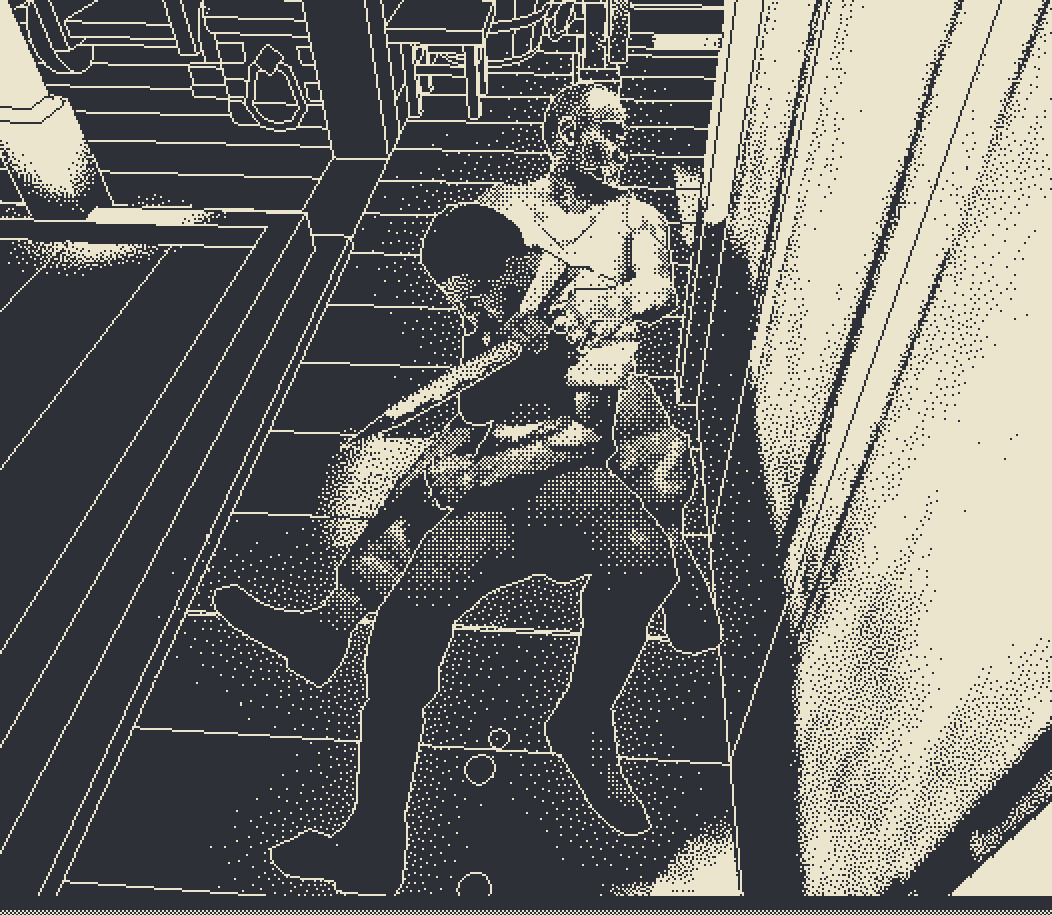
The pair are last seen together in Soldiers of the Sea Part 3, where they become caught up in the crab riders' invasion on the gun deck. Gibbs asks what's going on and Nathan Peters warns the crew to hide in reply. Smith seems to be keen to listen to this advice, but Gibbs, who is carrying an axe at the time, is eager to fight back and encourages Smith to join him. Smith urges him to get down but Gibbs ignores this, taunts the crab rider, and throws his axe at it. The crab deflects the axe with one of its legs and the rider launches several spikes at Gibbs in retaliation, killing him instantly and also stabbing Smith in the shoulder as he attempts to pull Gibbs to safety. Smith manages to survive this injury, at least for the time being. In Part 4, Peters has pulled him to safety behind a wooden partition and peeks around the corner to look for more danger while Smith clutches the spike in apparent pain. The pair seems to make an alliance at this point, and devise a plan to ambush the crab riders in the cargo hold.

In Part 5, Smith is seen stumbling down the stairs to the orlop deck, the spike now removed from his shoulder, as Peters accompanies him. They look on as Charles Hershtik and the first crab rider, the one which killed Gibbs and injured Smith, die in a blaze of glory and horror. Subsequently in Part 6, Smith asks Alfred Klestil to give him the hand mortar in his hands while Peters opens the hatch to the cargo hold. They do not appear in Part 7, but are presumably preparing themselves for their ambush against the second and final crab rider. Finally, this plan comes to fruition as the crab rider enters the cargo hold via the forward stairs. Smith shoots it with his hand mortar while Peters stabs the crab with a spear from behind the stairs. In the process, the crab rider stabs Smith in the chest with its own spear, while the crab's pincers impale him in the torso, killing him once and for all.
Interpretation
I think resilient would be the best word to describe Smith based off of what we see of him in the game. Obviously, he has to be quite resilient to even exist in his position as a Black American man, in early 19th century England. I'm sure he's faced quite a lot of shit over the years. But we also see his resilience in the more literal sense too, pushing through his pain to make a stand against the crab riders. He's probably quite a strong leader, since we see him take center stage during the ambush. Seems like a very admirable guy overall.
Headcanons
I figure he probably comes from somewhere up north in America, like New York or so, considering his status as a free Black man. I'd like to do more research into this topic one day though to make more fleshed out opinions on it.

11 - Marcus Gibbs
Role: Carpenter Mate
Origin: America
Appears in: 4 memories
Accepted fates: Spiked by a terrible beast, speared by a terrible beast
Story Summary
Marcus Gibbs makes his first appearance in Murder Part 2, where he stoically watches the execution of Hok-Seng Lau. His superior, Winston Smith, is also in attendance but the two are not standing close together. The pair are seen working together in Unholy Captives Part 3 though, as Gibbs saws a plank inside the carpenter's shop while Smith looks out the door at the unfolding commotion caused by the mermaids. In Part 4, they have paused their work to assist with the dead bodies that now litter the various decks, carrying a stretcher over to William Wasim so they can prepare him for a burial at sea.

Lastly, the duo appears together in Soldiers of the Sea Part 3, having been on the gun deck when the crab riders invaded the ship. Gibbs asks what's going on and Nathan Peters warns the crew to hide in reply. Smith seems to be keen to listen to this advice, but Gibbs, who is carrying an axe at the time, is eager to fight back and encourages Smith to join him. Smith urges him to get down but Gibbs ignores this, taunts the crab rider, and throws his axe at it. The crab deflects the axe with one of its legs and the rider launches several spikes at Gibbs in retaliation, most of which pierce Gibbs in the chest, killing him and pinning him to the wall behind him.
Interpretation
So I know it's popular to declare Gibbs (and Smith) as an absolute chad, a badass, what have you, for his actions in Soldiers of the Sea, and although I didn't really think about it that way, I saw where people were coming from. But as I've thought more about his actions over the years, I've started to get a slightly less favorable opinion of him. His superior gives him a direct order to stand down and not fight back against the crab riders, at least for the moment until they can prepare themselves more, but Gibbs explicitly ignores him, gives a cocky one-liner, and dies for it. Makes you wonder why Gibbs didn't listen to Smith, and perhaps what he is like outside of what we see in the game. And in combination with a closely related character in the same chapter, Nathan Peters, I think he makes for a great example of showing just how much we don't know these people, and we often make big assumptions about their personalities based on the very limited appearances they make in the memories (Read about Nathan on the seamen page for more elaboration on how I interpret him specifically).
Headcanons
Building off of what I mentioned in the Interpretation section, I've kind of developed a bit of an unsavory persona for Gibbs. It is also sort of inspired by some other nautical-themed media that I've consumed, namely The Terror TV show and The Wager, a nonfiction book by David Grann. Spoilers for both of those. In The Terror, the major antagonist is Cornelius Hickey, who does a bunch of heinous shit but starts out as a simple caulker's mate who makes repairs to the ship's watertight caulking. The Wager describes a carpenter's mate who acts recklessly, sort of commits mutiny, and possibly murders someone. And for some reason that stuck out in my mind for some reason, seeing two men in such unassuming roles becoming such menaces to their fellow crew members. And since we already see some signs of disrespect for authority in Gibbs it made me think, why not headcanon him as being the same? So I kind of picture him as a bit of a menace now, a bit quiet overall maybe but definitely having ambitions for greater things and not having the most favorable view of authority figures. Always taking any small opportunities that he can to "stick it to the man". Maybe if he survived Soldiers of the Sea and even The Doom, he would have participated in one of the mutiny schemes that arose near the end of the story.
Given the fact that the only two Americans on the ship are the carpenters, I have to imagine that they came over to England together as one collective unit. Like Gibbs was already working under Smith in America before they started working for the East India Company. So I imagine he's also from the northern states, to match my headcanon for Smith.

12 - Thomas Sefton
Role: Cook
Origin: England
Appears in: 2 memories
Accepted fates: Struck by the tail of a beast, crushed by a terrible beast, clubbed by a terrible beast
Story Summary

Thomas Sefton makes his first appearance in Murder Part 2, witnessing the execution of Hok-Seng Lau. He is accompanied by Emil O'Farrell, a goat, and Henry Evans's pet monkey. Meanwhile, Sefton is using a carving fork to scratch his head, the utmost paragon of 19th century food safety standards. His next and last appearance occurs in Unholy Captives Part 2. As the seamen are carrying the mermaids below decks, Sefton approaches from the galley to make small talk, joking about turning the mermaids into food. The seamen mostly ignore him, until he spots one of the mermaid's shells and seemingly attempts to grab it. John Naples warns him to get back but it is too late; one of the mermaids thrashes her tail in retaliation, striking Sefton across the face. The trajectory of his fall seems to suggest he strikes his head on the post of the railing after this, which likely killed him if the strike itself did not already do so.
Interpretation
Perhaps the only character in Return of the Obra Dinn whose entire existence is dedicated to comic relief. We get such a strong impression of him through his behavior in the only two memories he's seen in, he really seems like quite a character. A jokester, a class clown. But judging by the way the seamen ignore him during Unholy Captives, I feel like most people don't really appreciate his sense of humor haha. But maybe for good reason, because he also doesn't listen to Naples's warning to get back, while on a voyage that has already seen several people die. Maybe sometimes his jokes weren't always respectful?
Headcanons
One pet headcanon that I have relates to a piece of trivia about real world ship's cooks I read about once. Apparently, it was often common for old or injured seamen to transition into cooks so they can continue working in the same sort of environment as they did before, even after becoming physically unfit for their current position. I like to think this is Sefton's backstory as well, and, as he doesn't seem particularly old compared to most other crew, I imgine he retired due to an injury. I've always imagined it as a leg injury for some reason, one that's left him with a limp. Just seems fitting somehow.

13 - Emil O'Farrell
Role: Butcher
Origin: Ireland
Appears in: 7 memories
Accepted fates: Spiked by a terrible beast, speared by a terrible beast
Story Summary
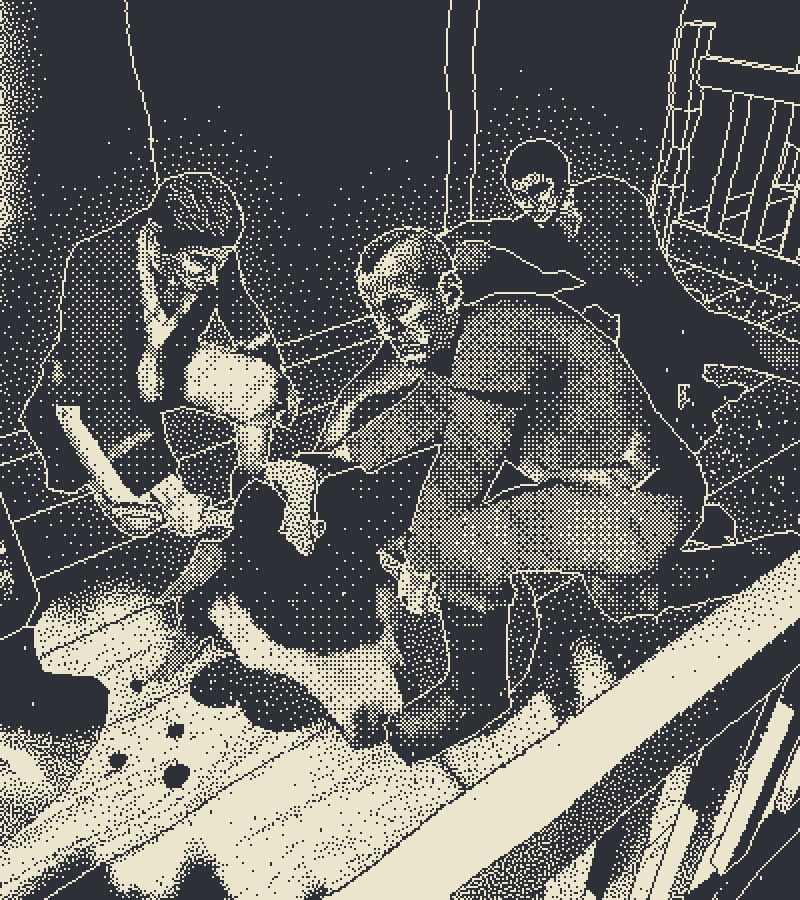
Emil O'Farrell is first seen in A Bitter Cold Part 3, where he is teaching the three midshipmen how to slaughter a cow. While Peter Milroy and Charles Hershtik pin her to the ground, he instructs Thomas Lanke to stun her with an axe blow to the head so that he can then slit her throat with a knife. When the resulting sensory overload results in Hershtik vomiting, O'Farrell warns the lads to not get their shoes dirty, either from the blood or the vomit. O'Farrell is also present for the execution of Hok-Seng Lau, accompanied by Thomas Sefton, a goat, and Henry Evans's pet monkey.
He appears in Unholy Captives Part 3, where he is only a few feet away from the stairs when the seamen tumble down them and William Wasim dies. His pose in this memory suggests he is wanting to help, but obviously is too far away and much too late to do so. He appears in Part 4 as well, looking down into the cargo hold at the bloody scene involving John Naples and Fillip Dahl. He and Edward Spratt are being prevented from going further below decks by Olus Wiater.

O'Farrell is seen participating in the battle against the crab riders in Soldiers of the Sea Part 4. In it, he wields a spear while the first crab rider traverses the orlop deck and kills James Wallace and Jie Zhang. He appears terrified, and urges someone to set the beast on fire to stop it. Hershtik listens to his plea, and tosses a lantern at it. The events between this memory and the next one are unclear, but we know that the aftermath of such events results in O'Farrell being impaled by several of the crab rider's spikes, pinning him to the outer wall of the port walk, with his spear on the deck beside him. The fact that he was stabbed in the back suggests that he was attempting to run away when he was attacked, perhaps heading for the cargo hold stairs just behind him. His face is contorted into an expression of agony, clearly in a lot of pain from his injuries, which were somehow not severe enough to kill him instantly. In the following memory, the nearby Henry Evans takes note of the injured O'Farrell and attempts to extract him from the wall while giving him brief words of assurance. O'Farrell is only able to make utterances of pain before dying, presumably of shock or blood loss.
Interpretation
O'Farrell seems like a pretty nice guy and I wish we got to see more of his personality in the game. I appreciate that he doesn't add onto the teasing that Hershtik receives after vomiting and instead offers helpful advice for the situation. And his presence in Unholy Captives Part 4 gives me the impression that he wishes to help out somehow rather than simply wanting to gawk. I imagine he was probably friends with Sefton to some extent due to the overlap in their roles on the ship, plus we see them together in Under Way and Murder Part 2. Though I imagine O'Farrell is the straightman to balance out his jokester personality.
There is something to be said for the fact that out of the three Irishmen aboard the Obra Dinn, O'Farrell is the only one that doesn't participate in Nichols's mutiny; I imagine that Galligan befriended and recruited O'Hagan by taking advantage of their shared background. O'Farrell's higher rank as an officer probably had something to do with him being looked over, and overall he seems to be more kind-hearted than would be suitable for such a scheme.

14 - Christian Wolff
Role: Gunner
Origin: Austria
Appears in: 6 memories
Accepted fates: Shot with a cannon by a terrible beast, shot with a cannon by Abraham Akbar, exploded
Story Summary
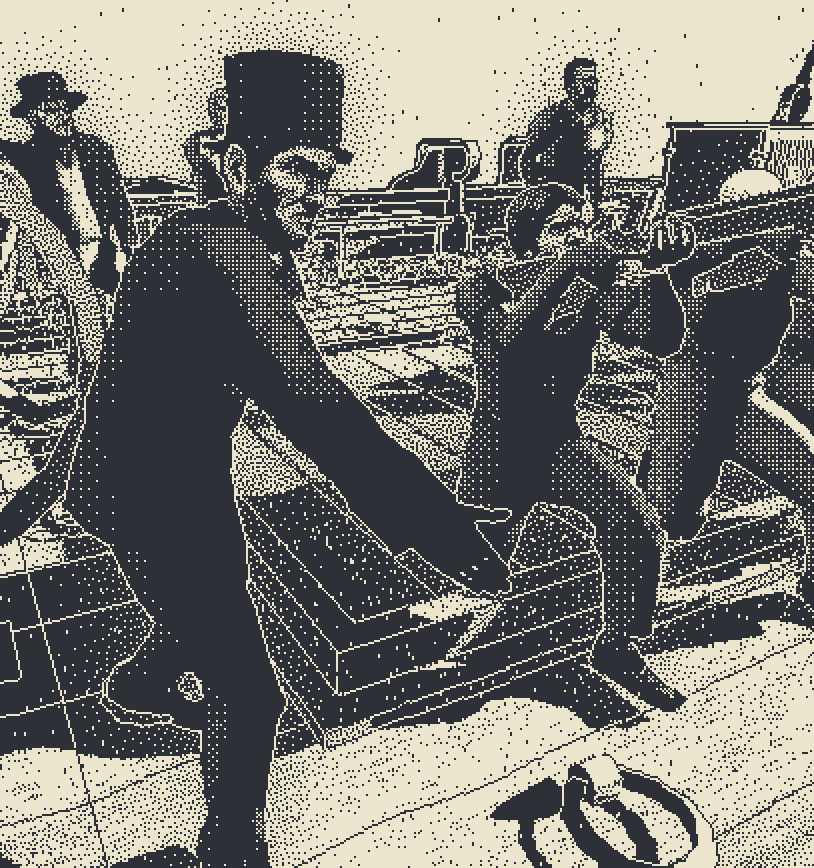
Christian Wolff has a key role in the execution of Hok-Seng Lau in Murder Part 2. In it, he stands at the ready in between Captain Robert Witterel and the firing line composed of seamen, waiting for Witterel to give him the go-ahead to fire. He then instructs the seamen to fire, one of whom hits and kills Lau. He is then seen in Unholy Captives Part 2, where he and a few other officers have gathered before Witterel as he presumably relays more orders to them. He has a musket in hand and is looking elsewhere, seemingly at the Formosan chest being taken back on board. Meanwhile, his mate, Olus Wiater, walks away seemingly to investigate the commotion coming from the gun deck.
Wolff's next appearance is in Soldiers of the Sea Part 4, where he mans the gunner's store so that the rest of the crew can be armed and ready for the battle against the crab riders. In the moment, he is handing a musket to Charles Miner, while Alfred Klestil leaves the area with a hand mortar. Meanwhile, Wiater opens up the hatch leading to the cargo hold. After a small gap in the timeline, he appears again in Part 7, still inside the gunner's store but now accompanied by Wiater. He appears to be grabbing another musket, seemingly for himself as no one is nearby to receive it from him, while Wiater puts a pile of swords on the counter for more sailors to grab.

Wolff is yet again at the heart of the battle during The Doom Part 3, where he directs a team of topmen and seamen in manning the cannons to use against the kraken. This plan goes awry when a tentacle reaches through one of the portholes and grabs a lit cannon and points it directly at Wolff, crushing Abraham Akbar in the process. Wolff tries to command the fuse to be put out, but no one is able to get to it in time. The tentacle then wraps around Wolff himself as well, trapping him in point blank range of the cannon. George Shirley attempts to free him but is seemingly pulled out of another porthole, leaving Wolff to his grisly fate. His body is absolutely decimated in the explosion, with the upper half of his body being almost completely erased, save for one arm and his signature tophat.
Interpretation
I haven't really come up with a strong characterization for Wolff, beyond that he seems serious and dedicated to his job, though I wouldn't say that's super unique among the officers. The biggest thought I have about him is that I don't think him and Wiater have a particularly strong relationship, like, they don't seem like friends or anything. Their relationship is very "straight to the point" and purely professional in nature. I also can't imagine him being down to commit mutiny if he survived The Doom like Wiater did.

15 - Olus Wiater
Role: Gunner's Mate
Origin: Poland
Appears in: 12 memories
Accepted fates: Shot with a gun by John Davies
Story Summary

Olus Wiater first appears alongside his superior, Christian Wolff, in Murder Part 2. In it, he kneels nearby Wolff and the firing squad as they carry out the task of executing Hok-Seng Lau. Next, he is again seen near Wolff in Unholy Captives Part 2. The pair - among other officers - are listening to Captain Robert Witterel on the main deck, though Wiater is seen walking away with a pistol in hand, presumably to investigate the commotion occurring on the gun deck as a result of Thomas Sefton's antics. He appears again in Part 4, where he is on the orlop deck preventing Edward Spratt and Emil O'Farrell from entering the cargo hold while John Naples's injuries are tended to and Fillip Dahl is aprehended.
Wiater also appears in Soldiers of the Sea Part 4, where he is opening up the main hatch down to the cargo hold for unknown reasons. Wolff is nearby handing out weapons to the other crew members. He then appears in the gunner's store alongside Wolff in Part 7, having placed a pile of swords on the counter for more sailors to grab, while Wolff seemingly grabs a musket.
He makes another appearance in The Doom Part 6, after the death of his superior in the battle against the kraken. In it, he is heading up the stairs towards the main deck with several muskets in his arms, but is about to fall over due to the ship's intense keeling. He recovers and gets up to the main deck by the time Part 7 takes place though, and there he can be seen tossing one of his muskets towards Alfred Klestil. Then, in Part 8, he is seen lying on the deck next to one of the staircases leading up to the aft deck, wielding one pistol in each hand. A musket lays besides him and he is aiming one of his pistols in the kraken's general direction.

Wiater and John Davies presumably carry the injured Alfred Klestil into the officers' mess in the aftermath of The Doom, and during Escape Part 1 he silently watches the conversation between Davies and Klestil. Klestil then dies of blood loss. Davies goes to sit in a nearby chair to grieve while Wiater remains seated on the dining bench. Some time seems to pass after this, where the two most likely engage in a conversation about recent events. This conversation captures the interest of Thomas Lanke, who eavesdrops on them from the hallway. In Parts 3 and 4, we hear Wiater suddenly declare that he no longer trusts Witterel. Davies asks him for a plan, and the gunner's mate explains that they should take control of the ship, head east, and sell the mermaid and shells for money. Then, Leonid Volkov screams from the main deck, which startles Lanke and causes Wiater to become aware of his presence. Lanke panicks, shouting for mutiny and attempting to run away. Wiater is quick to chase him down in retaliation and stab him in the back with a dagger a total of seven times. Davies comes to Lanke's aid and pulls Wiater off the boy, then the two men wrestle for control of the pistol attached to Wiater's belt. In what could either be an accident or act of desperation, Davies fires the gun while it is aimed directly at Wiater's face at point blank range, completely oblierating his face and a decent portion of his skull, which naturally kills him.
Interpretation
Oh brother this guy stinks!!!! I hate this man because he backstabbed my favorite character and indirectly got one of my other faves killed and I am not sorry about it. He doesn't really do much that is noteworthy before all of the mess in Escape happens, even being actively helpful at times, which can't be said for some characters that are less evil than he is. Despite how much I dislike him, it would be dishonest to call him useless or a coward. This committment to helping out either suggests he was playing the long game in terms of committing mutiny or he only developed the idea very recently. I don't really know which I lean towards more, he gives me the vibe of someone who has always been a bit sketchy and weird, someone whose presence in the same room as you makes you uncomfortable but you can never put a finger on exactly why that is.
In an attempt to be unbiased, I will say that I think there isn't anything that is uniquely evil about his decision to murder Lanke. I think anyone that was serious about a mutiny plan would've done the same to anyone who ratted him out in the way that Lanke did. It really only looks so terrible because his actions are set against those of two men who rushed to protect Lanke in their own ways, even when both of them may have been harboring mutinous feelings of their own. Hoscut and Davies are the exception to the rule, not Wiater. I guess I could say that the particular method he utilized was a bit cruel, choosing to stab him multiple times so he would bleed out instead of ending it with a quick shot with his pistol.
Headcanons
I am of the opinion that Davies was not the first person that Wiater recruited into his mutiny scheme. Otherwise the premise of the strategy becomes a bit ridiculous, planning a mutiny and the very first person you ask to join you is the fourth mate, one of the highest ranking crew members on board and therefore most likely to remain loyal? I think by the time he propositioned Davies, he had already recruited at least two people, Henry Brennan and Leonid Volkov. I feel like the idea that the three of them already had pre-existing plans would also do a lot to explain why Brennan and Volkov were already wielding weapons at the beginning of Escape before there was any sort of altercation going on. There is also a bit of a shared connection between Wiater and Volkov due to both of them being Slavic, for whatever that's worth. Besides this, I don't really have many more headcanons for this guy because I don't like thinking about him lol.

16 - Duncan McKay
Role: Purser
Origin: Scotland
Appears in: 6 memories
Accepted fates: Drowned by a terrible beast, fell overboard, eaten by a terrible beast
Story Summary

Although he does not appear in the memory itself, Duncan McKay attends the execution of Hok-Seng Lau, standing near the stern, seemingly very close to Henry Evans. His first proper appearance is in Unholy Captives Part 3, where he witnesses the death of William Wasim only a few feet away. He does not appear again elsewhere in the chapter.
Next, he appears in Soldiers of the Sea Part 5, where he has confined himself to his office to hide from the crab riders. He is leaning against the door with his ear pressed to it, suggesting he is attempting to listen to whatever is going on outside, probably due to the intense sound of Charles Hershtik's dying screams of agony. After this, he is seen taking cover in the back corner of the room, sitting on a small countertop in Parts 6 and 7.
McKay then appears in The Doom Part 1, where he is seen in the midst of an attempted escape from the ship along with seamen Nathan Peters and Alexander Booth. Lars Linde attempts to join them, but is rebuffed by Peters. McKay watches the altercation between Peters and Linde unfold without a word, as he holds a stack of books or ledgers in his arms. The trio then departs, and are not seen again for some time. They reappear in Part 7, where their boat is being launched high into the air by one of the kraken's tentacles, leading to their imminent deaths via drowning. Given the amount of time that has seemingly passed between these two memories, it may be assumed that the group attempted to return to the ship, for whatever reason.
Interpretation
This guy has to be the poster child for cowards of the Obra Dinn, right? It's basically all that we see him do. Running away after seeing the accident in Unholy Captives, hiding in his office during Soldiers of the Sea, and abandoning ship during The Doom; he doesn't even attempt to speak up against Peters's murder of Linde. To be somewhat fair to him, he probably doesn't have any combat training so he probably wouldn't have been any use in those situations anyway, but then again, that didn't stop Henry Evans from picking up a sword during Soldiers of the Sea. I'm not sure how I feel overall about his behavior, it's understandable and probably pretty "average" for someone in his position but that doesn't really cut it in this game where you have a lot of people being far braver than their positions usually demand. I do wonder whose idea it was to organize the escape he carries out along with Peters and Booth. It's such an odd juxtaposition of crew in terms of demeanor and position in the hierarchy. Booth doesn't seem a likely candidate for the creator of the plan, so it was either McKay or Peters. If it was Peters's idea, then I feel like McKay must have heard about it and "forced" himself into it, rather than being invited or something. And if it was McKay who organized it, it would make sense for him to ask two seamen with more "up close" experience at sea to help him, as he is really only trained for the financial side of sailing. I think at the time of writing this I lean more towards it being McKay's idea, but that may change in the future.
The fact that we see McKay holding a stack of ledgers while fleeing is a bit more interesting than one may initially think. It suggests that even though he is abandoning ship, he still cares about upholding his duties as purser on some level, maybe even intending to return to the East India Company's London office and drop off his notes so things can be properly worked out in regards to sailor wages. This contrasts a bit when compared to the actual survivors of the Obra Dinn, who settle in Morocco and have no intention of ever returning to their homeland. Maybe there is a way to read this action more cynically but in my current interpretation it does suggest a shred of consideration from McKay to "do the right thing".
Headcanons
Okay, time for a real world fact about pursers (from back in the day, not sure if it's still true). Have you ever thought about who the superior of the ship's steward would be? Obviously the captain's mate serves the captain and reports to him, same for the first mate and his steward, and so on. But who does the ship's steward answer to? Well, turns out it was the purser! So I imagine that McKay and Zungi Sathi have been working together for a few years and are fairly familiar with each other. McKay doesn't feel like someone that really has "friends" to me, he seems too dour and stern for that, but the pair at least gets along well and has a good working relationship. But. I also have a bit of a dark headcanon that adds off of this. During Soldiers of the Sea, after Sathi gets spiked and he starts crawling away, the path he takes goes right past the door to the purser's office. And in the memory where he has just made it past the office door, McKay is standing at it with his ear pressed against it. What if Sathi attempted to open the door or ask to be let in, and McKay heard this, but decided not to do anything to help him? Maybe he mistook the sounds he heard for sounds being made by one of the monsters, or maybe he didn't let him in out of selfish fear for his own life. Either way, Sathi was forced to keeping moving towards the port walk so he could be "safe", and that is unfortunately where he met his fate.
A few other random tidbits: McKay has a fairly prominent scar running along the left side of his face. Apparently, historically, most sailors didn't like pursers because they often utilized dirty business tactics and ripped people off, so I like to imagine this scar was inflicted by a sailor who believed that McKay was somehow taking advantage of him. McKay is the tallest crew member on board and the only person with a "tall" body type, which I think is kind of neat and adds to the somewhat intimidating aura he gives off (too bad he doesn't actually do anything with that). I also get the impression he is... ashamed of being Scottish? Maybe ashamed isn't quite the word I'm looking for - like he comes from a really small, really Scottish town but he tries soooo hard to come off as an upperclass Englishman. I think it makes for an interesting contrast with Hoscut, who is also a Scottish officer but seems to be proud of this fact.

17 - Finley Dalton
Role: Helmsman
Origin: England
Appears in: 2 memories
Accepted fates: Drowned by a terrible beast, fell overboard, eaten by a terrible beast, crushed by a terrible beast, torn apart by a terrible beast
Story Summary

Finley Dalton attends the execution of Hok-Seng Lau, though he is not captured in the memory of Murder Part 2 as his position at the ship's helm is too far away for the Memento Mortem's range. He first appears in a memory in Murder Part 3, where he is seen writing in pain due to a pole impaling his thigh, close to the helm. Evidently, he was among the people who attempted to stop the mutineers from escaping but was thwarted. He is not seen again until much later in the story, with his second and last appearance occurring in The Doom Part 8. Again, he is found close to the helm and is having a very bad time. Here, his leg has been grabbed by one of the kraken's tentacles and it is pulling him away as he clings to the aft deck railing. Since this is the last memory in The Doom and he does not appear in later chapters, it is safe to conclude that he lost his "tug of war" match with the kraken and was somehow killed as a result, whether that be via drowning or injuries inflicted by the tentacle.
Interpretation
It's a bit morbidly funny that the only glimpses we get to see of Dalton consist of him having an absolutely terrible time. We can't get much personality out of it, but at least we do know that he managed to recover from that initial injury he got during murder, so much so that he was able to return to work during the time of The Doom. I will also emphasize that a helmsman is technically a seaman, not an officer, so he was probably more friendly with the seamen and topmen than with the likes of Alfred Klestil or Duncan McKay.

18 - Edward Spratt
Role: Artist
Origin: England
Appears in: 5 memories
Accepted fates: Crushed by a terrible beast, strangled by a terrible beast
Story Summary
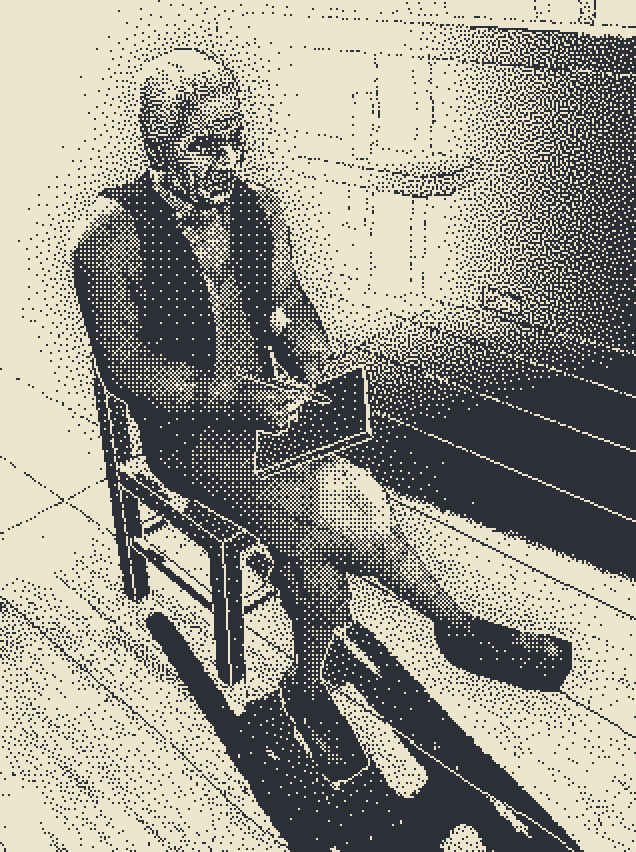
As the ship's artist, Edward Spratt is responsible for all the sketches of the crew and passengers that are present in the book sent by Henry Evans. During the festivities of the ship's departure from London, he made a sketch, titled "Under Way", depicting many different groups socializing and having fun together. He also made a sketch of the four Formosan passengers at their bunks, titled "Formosan Royalty". Lastly, the final sketch (and Spratt's first appearance in a memory) was drawn during Murder Part 2, where Hok-Seng Lau is executed before a large number of crew members. He can be seen sitting in a chair behind the Formosans, drawing the scene into his sketchbook. He then gives the drawing the title "Justice at Sea", and it reveals many characters who were present at the scene but did not get captured in the Memento Mortem's limited range of effect.
After this, Spratt appears in Unholy Captives Part 3, where he is running from the aft side of the orlop deck, towards the commotion involving the seamen and mermaids. His sketchbook can be seen in his hand here. He continues to linger at the scene in Part 4, looking down into the cargo hold along with Emil O'Farrell with his sketchbook still in hand, though both are prevented from approaching closer by Olus Wiater. He then makes a brief appearance in Soldiers of the Sea; he can be seen peeking through one of the small peepholes in the starboard walk during Part 4. Understandably, a frail old man like him probably wouldn't want to get caught up in the heat of battle.

Spratt then meets his untimely and unpleasant end in The Doom Part 2. In it, he goes to the ship's head to relief himself from what sounds like a rather upset stomach. However, while he does his business, a tentacle wraps itself around him and squeezes him to death, making him the first victim of the kraken.
Interpretation
I think the most interesting thing about Spratt is that he is being paid by the East India Company to work as their artist (as demonstrated in the insurance assessment at the end of the game). I can really only think of one reason they'd want to hire for such a role, and that is to make propaganda for the Company. He draws the crew having a fun time at the beginning of the voyage and also shows how the law is upheld by the Company and Crown even though they are far from land, a perfect visualization of the empire's "right" to expand across the globe.
Given his role on the ship, I think it would fit for his personality to be a bit nosey, like he's always wanting to know what's going on in case it's something that would be good for him to capture as a drawing. I believe that is why he wanted to go down to the cargo hold during Unholy Captives Part 4, as we even see him holding his sketchbook in that moment.