Domagoj "Dom" Evans
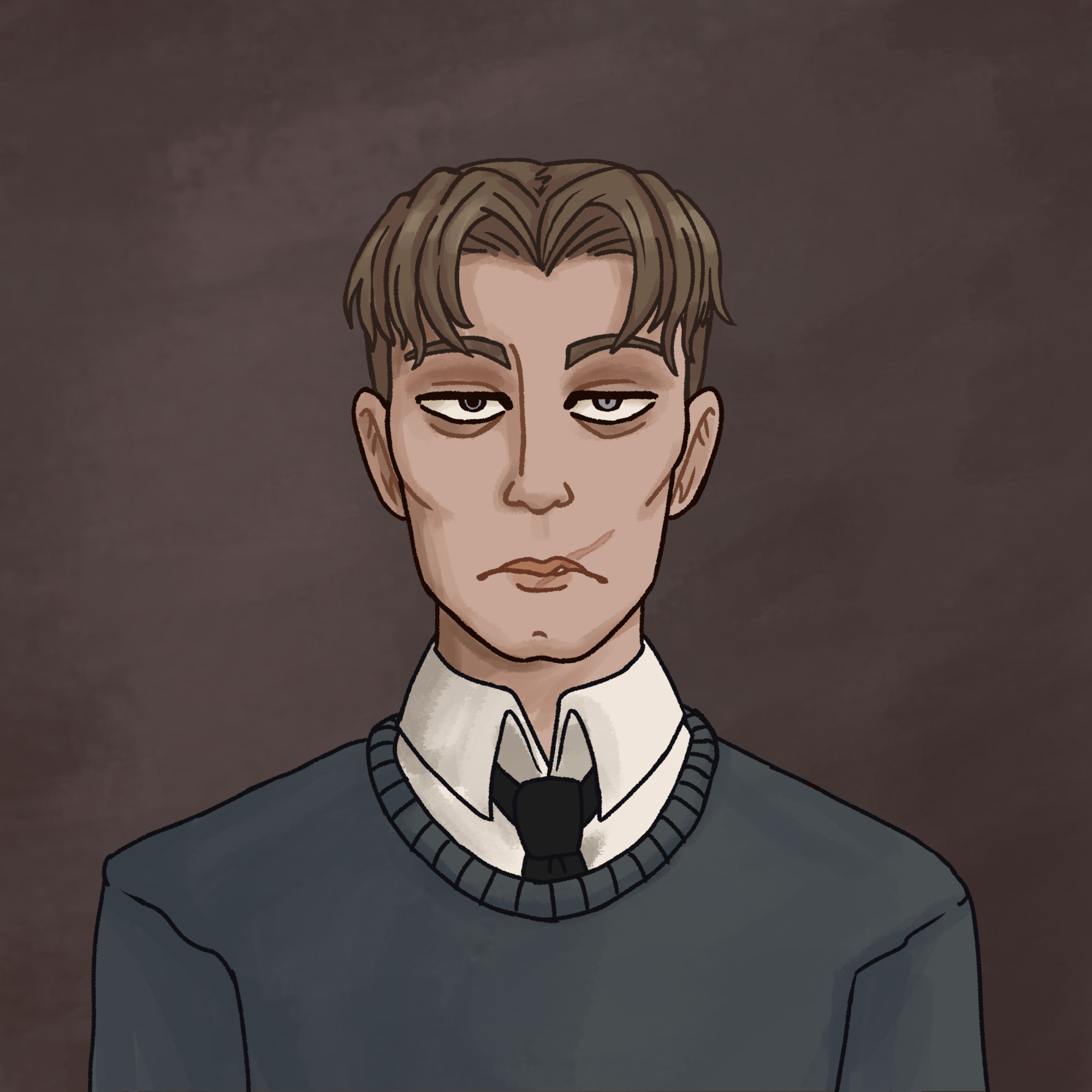
Character concept and design created by robee
Born: November 4, 1880 | Swansea, Wales
Rank: Surgeon, microbiologist
Height: 6' 1" | ???cm
Polar experience: One expedition
Morbidly fascinated with death, illness, and other similarly gruesome things. Willing to do anything for the sake of scientific progress, mostly fueled by a desire to find and push past the limits of the human body. Doesn't like to mince his words, but more than happy to lie if it is needed.
Biography
Early life
Domagoj Evans was born into a large family, with a Croatian mother, a Welsh father, and seven other siblings. He was the oldest, but it was the second born, a daughter, who often had to help his melancholic, distant mother manage the others while their father was kept busy with work. Evans was naturally very bright and inquisitive from a young age, and with his abundant and mostly unsupervised free-time, he took to exploring and experimenting with his local surroundings in an attempt to learn more about him. He even managed to prove that God didn't exist - or, at least, that He didn't care enough to punish Evans for the sinful things he did when no one was around to see. During another one of these excursions, when he was quite small, he encountered something he had never thought possible: a red fox, not uncommon in Wales on its own, but the creature had evidently survived some sort of vicious attack or disease that left it with half of its face rotted away and malformed. And yet, it moved with an admirable amount of urgency and even watched Evans with its one remaining eye, glimmering with what he had to assume was curiosity. It made him wonder about the limits of what it was possible for an animal, for a human, to survive.
Evans' interests took a turn for the macabre after this encounter. It didn't fulfill him to bring harm to animals, but he was morbidly fascinated in how they responded to harm, and how bad things could get before their ability to persevere gave out. And with his father being a doctor, he also began to wonder how scientific advancement might be able to push humans and animals alike beyond their natural limits, not just to survive, but to thrive, to do things even a normal, completely healthy individual could not. His family never took enough notice to direct his interests into more lighthearted topics, only paying enough attention to compliment his eloquence and intellect. Upon reaching adulthood, Evans pursued medical training, with a specialization in infectious diseases and microbiology. While in school, he picked up the habit of getting into recreational knife fights with some of the other students - a way of releasing tension and recharging his energy, he claimed. During one of these fights, his opponent dealt a rather nasty blow to his face, slicing open his top and bottom lip. Evans patched up this injury himself, and the scar lingered with him for the following years.
Extreme Conditions
Naturally, with his interest in pushing bodies to their limits, Evans was very interested in the recent explorations of the world's most extreme and inhospitable continent: Antarctica. He decided to join in on the fun, but his particular area of study was not in high demand for expeditions' scientific teams at the time, so he settled with merely being an assistant surgeon instead. He was paired with Cecil Rycroft, a fellow surgeon and former missionary. The two worked together on their first expedition well enough, but that trip was a fairly uneventful one on the whole and Evans had no cause to mention his more Promethean tendencies to the older man. The pair subsequently signed up for the Enlightenment Expedition. Evans was sure that the continent would yield something that would justify his interest in it, and he wanted to be there for it.
The Disease
About a month into the expedition, a few crew members, mostly seamen, came to the surgeons reporting troubling symptoms: lethargy, bruising easily, joint stiffness and pain, and below average body temperatures. Of course, these were some textbook symptoms for scurvy, and Rycroft and Evans agreed to treat these patients for the disease accordingly. However, the dog handler, Kyrre Mortensen, reported seeing similar symptoms in his dogs but claimed that dogs were unable to get scurvy, and therefore the disease they were seeing had to be something else that needed to be investigated further. Evans was intrigued by this, but still couldn't find himself taking the lowly manual laborer's claims seriously. He didn't say as much to Rycroft, but he decided to keep a closer eye on the patients' symptoms than they typically would, just in case.
Mortensen refused to drop the subject though, and so the issue was brought forward to Captain Theodore Hawthorne. Hawthorne deliberated for a while but sided with the surgeons. Mortensen reacted negatively, but was nevertheless allowed to do whatever he wanted to help his own dogs as long as he didn't interfere with the other crew's work, especially the surgeons. And so, Rycroft and Evans continued as they were, treating the illness their human patients were battling as though it were scurvy. Eventually though, it became very clear to Evans that their symptoms were not responding to treatment, and in fact were getting worse. Their joints began to lock up completely, with their body temperatures plummeting even lower. Rycroft conceded that they had stumbled upon something new, and decided to call the mystery illness "Austral Hypothermia". Evans volunteered to do most of the documentation and research into the disease himself, while Rycroft busied himself with providing comfort to the patients.
The First Autopsy
Evans was fascinated by the development of Mortensen's death. He found the red blood and viscera to be a very striking contrast to the white snow that it all sat upon. Due to the unusual circumstances, he and Rycroft were called upon to do an examination to find any possible clues as to the precise cause of death. The absolutely disastrous state that Mortensen's body was in made it difficult for any major conclusions to be reached, but they theorized that it couldn't have been possible for human hands to cause the injuries he sustained; it must have been some sort of animal with plenty of sharp teeth. Evans was not present for Rycroft tending to the injuries that Hawthorne sustained in the attack. If he had, though, he would've been very keen to study Hawthorne further for any other unusual characteristics. But soon enough his attention returned to the treatment of Austral Hypothermia. Symptoms continued to worsen but it was as of yet unclear where the ceiling would be - just how bad things would get - and Evans was teeming with curiosity to find out.
Studying the disease took up much of Evans's time in the following days, so it was of little concern to him when it was announced that a small party would be making the trek to find the animal that had attacked Mortensen. He also did not attend Lawrence Brewer's presentation of his findings, revealing that the animal they found, the snow griffin, was not Mortensen's killer as had been believed by the crew. The things he heard about it after the fact were of mild interest, but he did not buy into the fear-mongering about the rising threats posed to the camp.
UNDER CONSTRUCTION :-)
Appearance
Taller than average with a slightly slender build. His face is chiseled, with prominent cheekbones, strong jaw, and a cleft chin. His skin has olive undertones and his hair is a dusty, light brown with a straight, brittle texture. A scar runs diagonally across the left side of his mouth, caused by a knife wound. His eyes are dark and sullen, with a greyish blue color. He has anisocoria affecting his right eye.
Often has a somewhat hostile look on his face that makes him intimidating to approach. Sometimes smiles in conversation but it never really reads as genuine.
His voice sounds like he's always on the verge of sighing. Speaks formally, and sometimes peppers complex or uncommon vocabulary into his speech. It is very hard to get a rise out of him. Hums to himself when deep in thought.
Trivia
- Evans's surname was borrowed from Henry Evans, the surgeon in Return of the Obra Dinn.
Gallery
Portrait - 2026
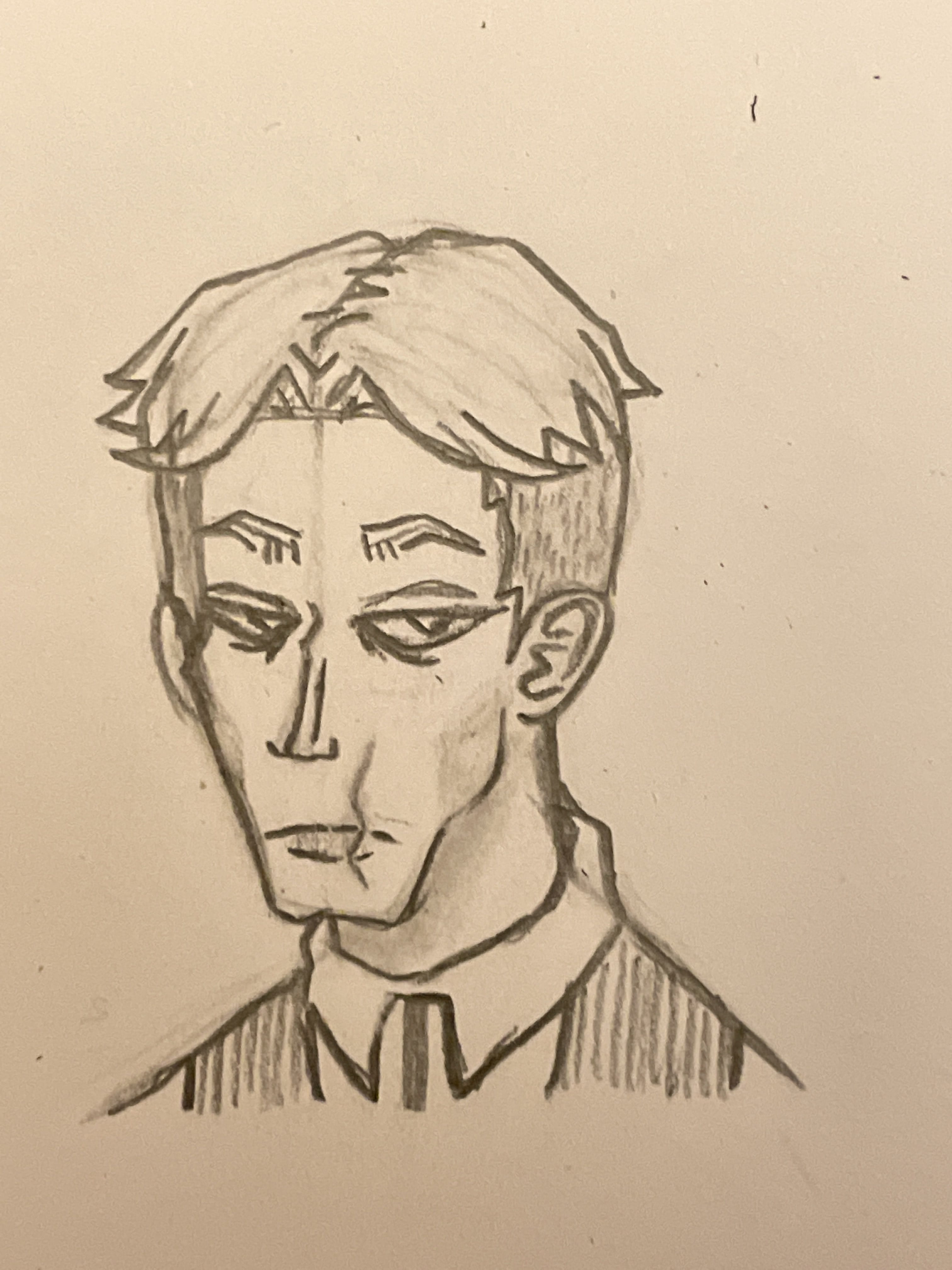
Portrait by robee - 2022
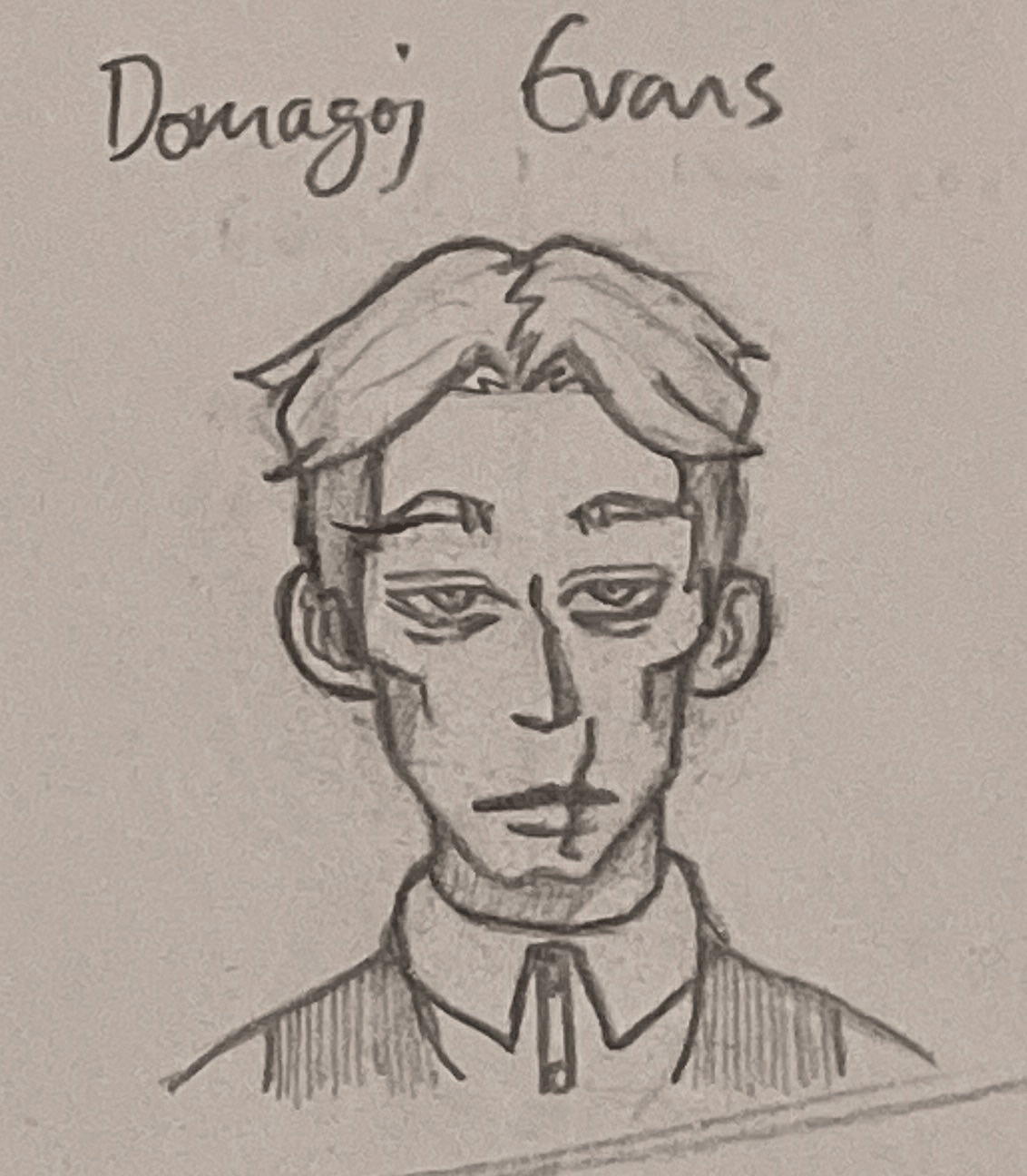
Portrait by robee - 2021